
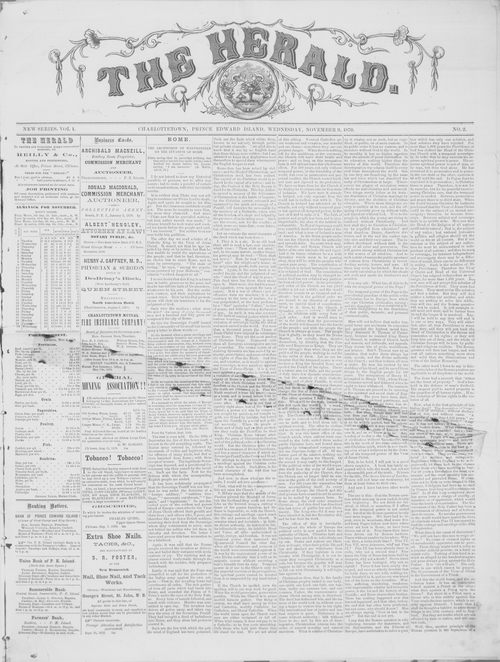
Edited Text
4
NEW SERIES. VOL 1.
=
CHARLOTTETOWN, PRINCE EDWARD ISLAND, WEDNESDAY, NOVEMBER 9, 1870.
NO. 2.
“SRB RBRALD
As PRINTED AND PUBLISHED BYERY WmenesDAY
MORNING, BY
MBILLY & Co.;
EDITORS AND PROPRIETORS,
Al their Office, Prince Street, Ch’lown.
TERMS FOR THE ** HERALD:”
£0 9 0
half-yearly inadvance, 0 10 0
For 1 year, paid in advance,
aa a as
Advertivements inserted at the usual rates,
JOB PRINTING
Of every description, performed with neatness
and despatch aid on moderate terms, gt the
Merawp Office,
—————
ALMANACK FOR NOVEMBER.
MOON'S VIHASES.
Funt. Moon, 8th day, 3h. 20m., morn., 8, W.
Last Qvanrer, 16th day, 4h, 47m., morn., N.
New Moon, 22d day, 9h, 9m., even., N. W.
First Quanten, 20th day, Gh. 21m,, even., N.
Fs]
| DAY WEEK — | roo HIGH | DAY'S
AG rises|sets , sets |water|len'th
hmhimh mh m hm
1 (Tuesday 6 464 42imorn, 4 46/9 56
2 | Wednesday 47; 40) 0 42,5 3+] = $3
3 | Thursday 49} 87/147;7 0 48
4 (Friday 50! 86) 247, 7 54) 46
& Saturday 62 34 3 48/8 41) 42
G Sunday 53| 83) 4 62) 0 28) = 40
7 |Monday 55) 31 5 5210 9) 36
8 |Tuesday 56) 30lrises (10 49) 34
|Wednesday | 57| 29/5 4011 24! 32
10 ‘Thursday 59, 27' 6 2Oeven | 28)
11 |Friday 7 } M7 0089 26
12 Saturday 9] 2517 60'1 21) 23
13 Sunday 3) 24,8472 4 21
14 |Monday B| 28 9 42/2 52) «(18
15 |Tuesday 7| 22:10 46 3 Bs 15
16 | Wedresday 8} 21/11 58 432) 13
17 /|Thursday 9} 20morn' 5 28 11
18 (Friday 10; 19) 1 71629 =
19 [Saturday 19) 18} 2 1917 32) 6
20 /Sunday 14; 17) 3 26, 8 30) 3
21 Monday 15] 16) 4 56 9 25) 1
22 ‘Tuesday 16] 15) 6 1410 298 59
23 | Wednesday 18} 15) sets 11 12) 57
24 Thursday 20) 16° 6 Gmorn! 06
25 | Friday 22] 1417 70 2 Si
26 |Saturday 24) 14,8 11,0 55) 60
27 |Sunday 25) 14, 9.20'1 50, 48
28 |Monday 26} 12)10 31) 2 44) «46
29 [Tue 26) 1211 35 3 36 46
“- [Wednesday 27| 12'mom| 5 B23) 45
: » Noy. toad:
Provisives,
cof, (small) r Ib. - ae. - ars
0. wy the Lom 4 a
Fork (eae 7 Seta Mp 3 ty Gad
Do. (smal + oe _ 60 w
Mutton, p 1: ly, oa
Veal, per Ib. oe 8d a 6d
Ham, per lb. -— - oe eo ee
Butter(fresh) - - + + Is 8d@ls bd
Do. by thetub - * ~ Isldals2d
Cheese, per Ib. - ._ - 3d a bd
Do. (new milk) = > + l0dals
Tallow, per lb. - - . - 7d add
Lard, per lb, - = : - - a0
Flour, per 100 tbs, - ” - 198 a 200
Oatmeal, per 100 Ibs. - - 17s 0d a 188 9d
Buckwneat flour per 1b. - - ljd a 2d
Eggs, per doz, - - - IsO0daisid
Grain
Rarley, per bush, - -*
Qats per bush, - ‘ “
3s 6d a 490d
23 3d @ 2s 4d
Vegetables,
Green Peas, per quart - - - 61 a od
Potatoes, per bush, . = lela tata
‘Turnips per bush, * « - 10d @ Is
Poultry.
Geese - - - . - 2s 6d a 3s
‘Turkeys, each = - - - - 4dsai7s Gd
Fowls, each = - - - - ls 3d @ 2s
- Is8da3s 0d
Chickens, per pair * «
ls 3d a Is Gd
Ducks - - - «
Fish.
Codfish, per qtl. - - - .
Herrings, per barrel - - -
Mackerel, per doz, - - -
Sundries.
Tlay, perton += - - .
Straw, perewl, + - - .
Clover Seed, per lb. - ’ - -
Timothy Seed, per bush, - -
Homespun, per yard . - -
Calfskins, per lb. - - - -
Hides, per lb, - - - -
Wool - - * ~~ -
Sheepskins - - . -
Apples, per bush, - » « 3s Od @ 4s Od
Vartridges ol - - 180d a ls 6d
Greoran Lewis, Market Clerk,
208 a 308
258 a 40s
- 668 a 75s
1s 6d a 2s
48aGa
6d ad
- 44d a4jd
ls a 18 6d
3s Od a 3s Od
Banking Potices.
BANK OF PRINCE EDWARD ISLAND !
(Corner of Great George and Ning Streets.)
Hion. Danter, Brenan, President.
Witiuam Cunpaus, Esquire, Cashier,
Thscount Days—Mondays and Thursdays,
Hours of Business—From 10 a, m, to 1 p, m.,
and from 2 p,m, to 4 p. m.
ya ‘The P. E. Island Saving’s Bank is in
connection with the Treasurer's Office, Days of
«leposit: Tuesdays and Fridays, from 10 a, m.
no 3 p.m.
Union Bank of P. E. Island.
(North Side Queen Square )
Crantes Parmen, Esquire, President.
James Anpenson, Esquire, Cashier.
Discount Days—We-'nesdays and Saturdays.
Hours of Business—From 10 a, m, to 1 p. m.,
and from 2 p. m, to 4 p. m,
Summerside Bank,
Central Street, Summerside, P. KH. Island,
President—James L. Houtman, Esquire,
Cashier—R. McC, Stavant, Eequire.
Discount Days—Tuesdays and Fridays,
Hours of Business—~10 a, m, to 12 p, m., and
from 1 p. m. to 12 p. m.
Farmers’ Bank,
Rustico, - - P. B. Island.
President—Jrnome Dorron, Faquire.
Cashier—Manin J. Buancnarp, Esquire,
Discount Day— Wednesday in each week,
<
|
Business Cardg,
ARCHIBALD MACNEILL,
- Reading Room Proprietor,
COMMISSION MERCHANT
AND
AUCTIONEER,
Cnar.otretrown, - - - P. E, Isuanp.
RONALD MACDONALD,
COMMISSION MERCHANT,
AUCTIONEER,
—AXD—
COLLECTING AGENT.
Souris, P. E. I., January 2, 1870. ly
ALBERT HENSLEY,
AYXORNEY AE LAV
NOTARY PUBLIC, &c,
Orricr :—T wo doors below Bank of P. E. I.
Great George Street - - ~ Ch'town.
December, 1869,
HENRY J, CAFFNEY, M. D.,
PILTYSICIAN & SURGEON
OFFICE IN
Des DPrisay’s lock,
(Next Apothecary’s Iall)
QUEEN STREET.
RESIDENCE:
North American Hotel,
Charlottetown, August 3, 1870.
CHARLOTTETOWN MUTUAL
FIRE TMSURANCE COMPAMY!|
Board of Directors for the current year:
How. Groner Bren, President.
_ TH. J. Calbeck,
lohm Scott, Esq.,
William Dodd,
ly
William Brown, Esq.,
Kertram Moore, Esq,
Esq., W. E. Dawson, I'sq.,
Robert Hooper,
W.E. Dawson and
John Scott, Esqrs. or Apptiiivers,
Office hours from 10 a. m. to 4 p. m.
HENRY. PALMER, Sec, & Treasurer,
Mutual Fire [Insurance Office, }
May 7th, 1870.
Gi Wer aw
MINING ASSOCIATION 11
AM authorized to give orders on the Mines
belonging to this Association, for Cargoes
of COAL, on favorable terms, at prices named
below, viz :—
Isl’. Cy,
Old Sydney Mines, Large, $2.25 13s. Gd.
hd +f Small, O74 da. Cal.
Albion Mines, Pictou, Large, 2.25 13s. 6d.
" “ Small, 1.25 7s. Gd.
Lingan Mines, C. B., Large, 1.74 = 10s. 6d.
“ bd Small, 0.80 = 4s, id.
Coal delivered free on board at the loading
wharves at the mines.
A discount allowed on Albion Large Coal,
for quantities over 30 tons,
G. W. DrBLOISs,
Ch'town, Aug. 31, 1870. 3m
i
Tobacco! Tobacco!
SE aaeeeamaeel
HE Subscriber having removed next door
to the old Stand, begs leave to intimate
to bis patrons and the public in general, that
he has fitted up a new Tobacco Factory, on
an extensive scale, from which he will supply
his customers on the most liberal terme.
Also, on hand, a large assortment of Fancy
PIPES. 20,000 CIGARS, 400 boxes LOZEN-
GES, 800 dozen SHOE BLACKING, 12
gross BLACKLEAD, 8 cases MATCHES,
besides a large assortment of
CAIZOOEWRLIES,
To which he invites the attention of intend-
ing purchasers, A
CHARLES QUIRK,
Upper Queen Street.
Ch'town, Sep. 7, 1870. 3m
Extra Shoe Nails.
TACKS, &C.,
ARE MANUFACTURED BY
R. FOSTER,
AT THE
8,
New Brunswick
Nail, Shoe Nail, and Tack
Works.
Orrice,—Warckouse and Manufactory,
George's Street, St. John, N. B.
All goods in this line, of
Superior Make and Extra Finish,
are kept constantly in stock, and supplied at
FAR Lowen RATES than can be purchased for
In any other Market.
ba” OnveEns souiciren.
Prompt Attention and Satisfaction
guaran :
Sept. 21,1870. 2m
ROME.
tt tt tala atta ath net fa at tint,
THE ARCHBISHOP OF WESTMINSTER
ON THE INVASION OF ROME,
Pilate seeing that he prevailed nothing, but
that rather tumult was made, taking water
washed his hands before the people,
suying, ‘I am innocent.” (S. Matth.
xxvil, 24.)
T do not intend to draw any historical
parallels of persons, nor to afliix any
names; but to make a parallel of certain
motives and actions, with their inevitable
results.
It is evident that Pilate was not wil-
ling to condemn our Divine Lord to death.
Again and again he sought to let Him
go. But the clamorous multitude would
not. The more he sought to save Him,
the more they clamored. And when
‘* Pilate saw that he prevailed nothing, |
but that rather tumult was made,’’ to
cleanse himself he took water and wash-
ed his hands before the people and said,
‘*Taminnocent.’? But neither God nor
man holds him guiltless.
The other day we read aletter of a
Catholic King to the Vicar of Jesus
Christ. It stated, not that he was im-
pelled by duty or by justice, but that he
was unable to resist the aspirations of
the people; and that he had, therefore,
no choice but to enter Rome, and to
seize its sovereignty, ‘The state of
feeling,’’ he says, ‘among the popula-
tions governed by your Iloliness,’’ con-
stitutes ‘evident dangers to all,”
T do not doubt that this King is a brave
man in battle, generous to the poor, and |
that he has still the faith of his ancestors,
whatsoever be his acts, But the multi-|
tude clamors, and their aspirations he
cannot resist. ILow far his filial protest-
ations will clear his innocence is for the
judgment of God.
Such were the motives; what were
the acts? An army of oivty thaneond
men and a hundred and fifty guns en-
compassed the city of Rome,
On this the Sovereign Pontiff issued
to the Commander of his small but heroic
army @ letter in these words ;—
At this moment when a great sacrilege and
the most enormous injustice are about to be
consummated, and the troops of a Catholic
King, without provocation, nay, without even
the least appearance of any motive, surround
anc bésiege the capital of the Catholic world,
I feel in the first place the necessity of thank-
ing you and our entire army for your generous
condies: to the present time, for the affec-
tion which you lavegehown to tlhe Holy See,
and for erent , yong your-
selves entirely to LO-
polis. May these words be a ple oh
ment to certify the discipline, the loyalty, and
the valor of the army in the service of the [oly
As far as regards the duration of the defence,
I feel it my duty to command that this shall
only consist in rotest as shall testify
to the violence t ne to us, and nothing
Such are the facts which refute them,
known to me not only through public
but private channels. ! am glad also to
know that it was by no buglish band
that these things were written: but I am
ashamed to know that Englishmen lend
themselves to spread them wheresocver
the English tongue is read.
Rome then has been seized by viol-
ence 3 and the Healof Christendom, and
Christendom itself, has been robbed.
|The capital of the Christian world is re-
; duced to the capil of a nation; and to-
day, the Festival of the Tloly Rosary is
fixed for the Plebiscite. This day, hither-
to sacred in memory of the deliverance
of Christendom inthe battle of Lepanto,
by the Christian powers, animated and
sustained by the spirit and energy of a
PontitY, will herea'ter be memorable for
the mockery of a Plebiscite, taken with
all the freedom of a siege. and helped by
the presence ofan invading army, Sach
are the events, now for the results; of
which some are immediate, some future,
but all inevitable,
Let us estimate the moral character of
the deed which has been dune—
[, First it is a sir. In an old book
there stillis read a law, now obsolete.
which rons: ‘*Thouw shalt not steal,’
and, in the same statute, another forgot-
ten precept may be read: ‘‘Thou shalt
not covet.’’ Now, he that ‘aspires by
force”? after his neighvour’s house, or
his neighbours goods, both covets and
steals. Again, in the same book is re-
corded the sin and the judgment of one
who ‘shed the blood of war in peace.’’
This deed then has these three stains
upon it. Once more, this deed is a mani-
fold injustice, even against the laws of
nature, It is a war of offence; and all
offensive wars are murders: it is also
contrary to the laws of warfare, for it
was perpetrated, as the doer professed,
by a “Son” againsta ‘ Father,’’ in time
of peace, and withonteven a declaration
of war, As such, it was also contrary
to the laws or natural justice which bind
nations towother, . Moreaver. it was 9
violation of sovereign rights, the oldest
and most. sacred inthe world, For more
than a thousand years the Vicars of
Jesus Christ have reigned as sovereigns
over Rome. They are the most ancient
of Christian kings. Compared with
them all European sovereignties are but
of yesterday. The crown rights of all
existing dynasties are less sacred by an-
tiquity, prescription, and possession than
the rights of Pius the Ninth, And this
sin, and injustice, as it would be against
any sovereign, is aiso sacrilege against
the Vicar of Jesus Christ, It is a viol-
ence against a pergon who is sacred, and
a violation of sac The sover-
eignty of Rome is a sacred trust Wrbe-
half of the whole Christian world. The
freedom of the Church and the liberty of
the truth are contatned. nit. Pius the
more: in other words, that negoti for
surrender shall be opened so soon as ach
shall have been made.
Ata moment in which the whole of Europe
is mourning over the numerous victims of the
war now in progress between two great na-
tious, never let it be said that the Vicar of
to give his consent to a great shedding of
blood. Our cause is the cause of God, and we
put our whole defence into His hands, From
my heart [ bless you nd your whole army.
Porn Pies run Nintit.
From the Vatican, Sept. 19th.
The rest is soon told.
September the fire of five hours made a
breach in the old crumbling walls. The
Italian army entered in, followed by
thousands of exiles and fugitives who,
for offences of many kinds, had fled or
been banished from Rome; with them
troopsof women. The legitimate Sover-
eign was deposed, and a provisional Go-
vernment was then named by the invad-
er. Such are the facts. Now for the
fictions with which the unsuspecting
English people are misled.
It has been sedulously propagated
that the Sovereign Pontiff was not free ;
that he was under the dominion of a
‘foreign soldiery,’”’ ‘ruthless _hire-
lings,’’ ‘‘ mercenary cut-throats,’’ * fan-
atics,”’ and “ legitimists.’? So are des-
erihed same of the noblest and purest
blood of Europe—men who for the Vicar
of Jesus Christ offered their wealth and
their lives ; and others who, if poor, and
therefore like our brave British soldiers,
receiving their food from the Sovereign
whom they volunteered to serve, were
not behind the nobles who led them in
chivalry and devotion, The letter 1
have read proves this base accusation to
be a falsehood. &
Again, it was said that the Roman
people received the invaders as deliver-
ers, and hailed their entrance with accla-
mations of joy. The rejoicing and ap-
plause entered ready-made through the
breach with the invader, duly prepared
beforehand,
Lastly, it was said that the Pope was
compelled to call for the protection of
the Italian army against his own sub-
jects :—That is, the invading hosts had
overthrown all order, The mob gather-
ed from all parts which had burst into
Rome, and crowded the Piazza of 8.
Peter’s under the eyes of the Holy Fath-
er. Every form of tumult followed, and
insult with violence. Murder was com-
mitted in open day. The invaders had
driven all police away, and taken cap-
tive the ariny of the Sovereign Pontiff.
They had brought a flood of turbulence
into Rome, “a they alone had power to
control it,
Such are the lies with which the pub-
lic mind of England has been poisoned,
Jesus Christ, however unjustly assailed, had |
On the 20th of |
Ninth received it from his prede«vasars
as a trust, and is bound before God to
hand it on in those who shall
come after, Ifis"tWone is not that of
earthly right alone, but.of the Vigwe of
Christ ; a power not won by conquest,
nor sought by ambition, nor bought by
| gold, nor filched by intrigue, but forced
upon the Pontiffs by a motl and politi-
cal necessity. When the people of
Rome and of Italy had ne dther protect-
ors they made the Pontif\to be their
King. Christian Rome berame alter-
| wards the germ of Christiay civilization
and of the political order of the Christian
world, But the Christian @der of the
world is a creature of Divine Providence,
and has a sacred character € which the
Sovereign Pontiff is the Cente and ITead.
The attempt to depose himis therefore
a sacrilege against the Chistian order
of the whole world. Such,then, is the
moral character of the dejd that has
been accomplished.
And now, to show what/are the re-
sults, I would ask two quesions—
First, what will be the coasequence of
this act upon the Church ? |
S. Hilary says that the wounds of the
Passion pierced the Manhaod of Jesus,
but the Godhead they could not reach.
Like as the keenest weapiw cutting a
flame of fire passes harmless, and the
flame is impassible, so with the Charch,
this outrage and sacrilege cannct reach
the life and powers of the Church. It
remains intact and inviolable ; its faith,
its divine authority, its indefectile life,
its indissoluble unity, its infallible ead
and Voice, all alike undiminished in
purity, energy, and freedom, It was not
temporal power that sustained the
(Ecumencial Council the other day,
when all the influences and menaces of
the world were concentrated against it.
It was by the supernatural power of its
own Divine authority that it held on its
majestic course without swerving a
hair’s breadth from its duty. Temporal
power is of use to the Church only for
the peaceful exercise of its prerogatives,
Its spiritual power cannot be wrested
ry it-or suspended by any hand below
God,
If the Church be spoiled, even the
spoiling will in one way work for good,
When the world persecutes, persecution
purifies, While the Church is in peace
morbid humors gather, One thing is
certain, we shall have among us fewer
bad Catholics, worldly Catholica, lax
Catholics, and liberal Catholics, When
the world turns upon the Church such
men are either reclaimed or fall off.
When trial comes, it does not pay to be
a Catholic; to be firm costs something.
Only those who hold faith dearer than
life stand the test. We are not afraid
of this sifting. Nominal Catholics are
our weakness and vexation, our scandal
and our shame: sometimes they are our
greatest danger. When thereis nothing
left for the ambitious, or the covetous,
the Church will huve more healil and
effect.
temporal power, or the friendship of the
world, but even in persecution and per-
petual conflict, the Church rooted itself,
and rose and ripened to its perfection.
We have no fears then for the Chureh if
of isolation,
world but in endless war with it.
Church in ireland has subsisted as by
miracle, not only without temporal pow-
face of it and in spite of it. The faith of
pastors and people has been and is inex-
tinguishable, the alms of the faithful in-
exhaustible. No Royal Supremacy could
ever establish itself over the faith of Ire-
the sun the Church wields its authority
and spreads daily. So,come what may,
the Catholic and Roman Church will
the Church is indeed immutable because
itis ordained of God,
cause God has not ordained any particu-
lar form of civil power. Inthe principles
and order of the Church we can yield
neither a jot nor a tittle, and the world
therefore counts us as fanatical and ob-
stinate: but in the political order we
are bound to no theories of govern-
ment, no special kind of constitution,
What is it, then, to the Church if
dynasties Camis wutvldy t
new its velations with every form of
civil order. . And it would seem to
ve in the future that the gavernment
of the world will descend into the hands
of the people; and with the people the
Church is always at home, ‘The people
hear it gladly, as they heard its Divine
Master,
themselves, by thinking that the Pon-
tiffs need Emperors or Kings. They are
never stronger than when they are the
guides of the people, walking to and fro
m the midst of them.
because a King has invaded Rome and
spoiled the Pontiff of his rights. There
is a future also for Italy, and the people
of Italy have few dynastic reminiscenc-
es, but the memory of their Catholic
I see many changes
ill never
ce
an 7 Rome
yet, but there is
change, the See of Peter
of the Vives of
The other question T
this: What will be the
this Act upon the world
it will reduce it to the o
from which it w vate
by Christian-
tw BE mission,
the one to convert indivlul ne by
one to faith, and to bind them into a
spiritual society, The other to civilize
and to elevate the political order of man-
kind. It was this latter office of the
Church which, when nations were con-
verted to the faith, united them under
public Christian laws, and boand them
together by intesnational compacts un-
der one Supreme Judge of all. Of the
former part of its mission, nothing un-
der God can deprive the Church, Of
the second it may easily be discharged.
If the political order of the world separ-
ates itself from the unity of faith and
from the authority of the Church, then
the Church can no longer fulfil its mis-
sion as the guide of the civil society of
men, For 300 years the separation has
been accomplishing itself, In every
country of Europe the Church and the
civil powers have ceased to act in unison
or to be united by common laws. In
Rome alone, the civil order remained
Christian, And this deed has dissolved
this last union of public law and Chris-
tianity. ‘The King who did it may not
have intended it, but the Revolution did,
and he has done its work.
The effect of this is inevitable.
Throughout the whole of Europe the
political order is now parted from the
authority of Christ. Christian faith and
Christian laws are left to individuals one
by one. States and nations are Chris
tian no longer, when their public life and
law and epnduct are withdrawn from
Christianity. If they legislate in con-
formity with Christianity, it is not be-
cause they recognize Christianity as a
rule, but because the popular will may
happen to fallin with it. If it happen
to fall out with Christianity it will legis-
late against it.
Christendom then, that is, the family
of Christian peoples united in one body,
one spirit, one Lord, one faith, one bap-
tism, under one common law, and one
common Father, the representative of
Jesus Christ among men, is dissolved
The deed has dethroned him, and the na-
tions of the world look on without mov-
ing a finger to restore him to his right.
The international law of justice and mu-
tual respect is gone. Diplomacy isa
name without authority; talk without
force to do; and, by this act of disin-
tegration, Christendom returns into the
order of natural morality and nataral
sanctions. What it retains of Christian-
ity. The Church Wt®a
it Can re-|
Let nobody, then, deceive!
ity it retains, not as such, but as expe-
dient, or politic, or of mere custom. In
its public order it has no custom, and is
therefore without God in the world. In
j its morality it has no higher sanction
) than the awards of penal retribution. In
service of this world. Therefore this
}
civil State throughout the world,
by one they are dissolving by the same
‘law and force which has dissolved the
| unity of Christendom at large. Where-
soever the plague of revolntion enters
|
education. Where these things are, so-
| ciety is smitten at its root, and the off-
Jand therefore without God,
people in which the young are rising to
‘manhood without Christianity. And
jhow shall they be Christian if Jhristian-
iity be expelled from education? and
land; and what is trac of Ireland is true| what dissolves States, dissolves also’ of “s
of America. In the freest people under homes, and in the end the canker eats] in politics and religion should set the
| world on fire dt all corners.
into men and their very nature, The in-
|tellect developed without faith is the
{prey of all crror and perversion. The
‘these may seem far-fetched,
avoided,
| You may ask: What has all this to do
| With
| ‘The temporal power of the Pope is the
providential guardian of the public order
of Christian law in Europe, from which
jour ripe Christian civilization sprung
and the dissolution of ¢hae cemporal pow-
jer 1gads straightway to the dissolution
,of that public, domestic, and personal
, commonwealth.
Men will not believe that under tem-
poral forms and accidents lie concealed
and guarded the highest moral laws.
They denounce S. Thomas of Canter-
bury, because he resisted King Ilenry
the Second, in matters of Church lands
and manors, and tribunals, and appeals,
They accnse him of pride, worldliness,
and avarice. ButS. Thomas saw by an
intuition, that under these things lay
(at stake. ILe won his contest by the
| Shedding of his blood, and he saved these
jthings to the English people for 400
years. The usurpations of Henry J
i triumphed in Ilenry VIII., whom 'Thom-
ought to have withstood,
) ofS. Thomas are proved to be unerring
in the spiritual and moral state of Eng-
w. The poor have been disin-
ty spiritual patrimony, and
its laws, has de-
P from
hear from our | 6
spoken latel
ry to be pe A parted, but
fearless ave @ true respect.
has deserih state of London as he
sees it, and as we Know jt to be. Anu
London of to-day is the legi fruit
vf the Crna Ge WRT = Me an to6g invents without doclara:
thin, ot the of war, and without cause.
ren
of civilization without Christianity, ana
this is the work of the same anti-social,
ing over what it believes to be the down-
fall of the temporal power of the Vicar
of Jesus Christ.
But, to be brief, T will put in a proof
above suspicion. A book has lately ap-
peared which tells the truth, but yet not
a thousandth part of the trath. It bears
for its title, Zhe Seven Curses of London.
If men will not hear our testimony, let
them at least listen to their own.
And now I have but two other words
to add.
The one is this: that the Roman ques-
tion which men say is now ended, is only
now beginning. Do not think mo fan-
atical, or blind, or senseless, if [ affirm
that the temporal power is not ended
yet; but that the Roman question is only
once more begun. We have had to re-
peat, even to weariness, that some five-
and-forty Popes before now have either
never set foot in Rome, or have been
driven out of it. Nine times they have
been driven out by Roman factions.
Times without number by invadors, Why
not, then,.a forty-sixth time? Pius VI,
Pins VII, were prisoners, wh¥ not Pius
Ixf
exile, ‘why not a second time? Nine
times the City of Rome has been held by
usurpers, why not a tenth? Seven times
Rome has been besieged, why not an
eighth? Twice it has been nearly des-
troyed, and once so utterly desolate that
for forty days, we are told, nothing hu-
man breathed in it, and no ery was heard
but of the foxés on the Aventine. War-
fare, suffering, wandering, weakness,
with imperishable vitality and invincible
power, is the lot and the history of the
Pontiffs ; and Rome shares their destiny.
There has nothing happened now that
has not happened, and that often, before;
the end that has often been predicted,
has not come, why should itnow? Men
are always saying “Now at last is the
end,’’ But the end is not yet.
I say that the Roman question is only
beginning, because tho statesmen, and
tho diplomatists, and the Princes of
Europe, have undertaken to solve a ques -
anti-Christian spirit, which is now exult-’
-erned, Masses whom
Pius 1X has been already once in |
tion which has only one solution, and
that solution they have rejected. For
more than 1,000 years the Providence ot
God has clothed the Head of the Chris-
tian Church with a temporal sovereign-
t : ‘ty, in order that he may exercise his sn-
peace: and so long as this usurpation |its education nothing higher than the! preme spiritual power in peace,
lasts it will atleast have this wholesome |
Ilis su-
or | preme spiritual power is not of man, or
For 300 years, not only without | disintegration rep: odaces itself in every by man, but from God alone
|
One
Ile has
| exercised it in prosecution and in peace.
‘Iu the one state or the other, exercise it
‘he will until the end, In Pagan days he
| exercised it in prosecution ; in Chriatiau
jtimes in peace. Therefore, itis not for
its destiny be to return into its first state | eflects are anti-christian and anti-social. | its exercise, bnt for its peaceful exercise
We have secn it already | Two things surely follow in its train: | among Christian men, that the temporal
in Ireland, not only seperate from the} the dissolution of Christian marriage by | power is needed.
The | divorce, and the abolition of Christian! and peace there is no third state. When
Between persecution
the world became Christian its instincts
proclaimed that the Vicar of Jesus Clirist
er but against all temporal power, in the | spring of society grow up without faith,| could be the subject of uo mortal sov-
Woe to the .
| reign,
' there is no middle state,
the ILcad of the Religion of all nations
ercignty ; thercfure, he became Sove-
Between subject and sovereign
Men saw that
could not be natural ; that is, the subject
nation; lest national jealousies
‘But Hf not
national or ‘tlie subject of any nation,
‘then he must be extra-natural or inde-
thrive of its own intrinsic life and vigor, | will grown strong without Christian law pendant ofall nations ; and then he must
And if its future relations be not with is the source of all rebeliion, And to! be sovereign, fur between independenco
dynasties which seem to be passing | such a state of nature the public apostacy | and sovereignty there may be a differ-
away, they will be withthe peoples who of natiuns from Christianity is re-con-! ence of sound, there can be no differenee
cannot pass away. ‘The constitution of ducting society, homes, and man. Alllin reality. Such is the solution of Di-
But so is}
The constitution | the early calculation by which the shoals! of Christ and Ilead of the Universal
of political socities may be changed be-|and_ reefs and sands are foreknown and) Church has reigned independent as sov-
vine Providence. Therefore the Vicar
ereign, for more than 1,000 years, Dus
!now men will not aceept this solution of
the temporal power of the Pope ? | the Providence of God. They must find
| another.
/and find a better,
neither a better nor another, and while
. | they are seeking to solve this riddle,
’
They must revise ILis sclution
But they will find
time will run, and the Roman question
will not be ended. It will entangle it-
self more and more, and be further from
_its end the longer it is uusolved. Nay,
| will be bold to say they will end it
in one or two ways. They will either
| find, after all, that Providence is wiser
| than they, and they will pnt back the
| lead of Christendon in the throne and
| possession of his rights; or they will
| keep him out of them, and the whole ot
Christian Europe will be torn by politi- -
cal and religious conflicts. The Roman
| question will then last longer, and will .
cost all nations something more stern
I : ; Let no one im faith, morals, and the divine authority , and solid than the illuminations and
y é vy rep “ari * . . .
imagine that the temporal power is over | of the Church; and that in them all were | Vivas of the Italian Monarchy.
The other word I have to say is this:
| The principles of the Roman question are -
applicable to all kingdoms in the world,
The Jews had a proverb that ‘tithes
and of their Pontifts, is vivid! as Cranmer served and flattered when he | are the fence of property.” God’s free-
The instincts | Wold is the defence of man’s freehold.
|The respect paid to sacred property is
| the guardian of all human rights,
If so,
the violation of Divine rights is the vio-
lation of all.
Now, what is the first principle of this
“A
nos it has net
broken down.
buy
in every cou
does not reach. They arethe remy ma-
terial for sedition and cofspiracy.
Englishmen believe England to be well-
governed; let them look to the classes
i below those who have anything to lose.
| Mor 20 years a Revolution the most sys-
‘tematic and the most stealthy has sur-
‘rounded and pervaded Rome. If coun-
| tries not far from us were treated in like
manner, if Belgium had been so treated
by France, how long would contentment
last? In all this long conspiracy there
/has never been a charge of cruelty, of
injustice, or of oppression, which would
bear the touch of examination The Go-
vernment of the Holy Father has been #
government of clemency and of forbear-
/ance to excess, No secular government
in the world would have spared the lives
of criminals whom Pius 1X has spared to
lead the outrage and sacrilege of the 20th
of September.
What then is the canse of discontent ?
“We will not have this man to reign ov-
erus.’’ No crime of violated rights or
j of unendurable oppression can be prov-
ed. These things might lend a color te
a popular judicial process, on a hard or
unjust ruler, Nothing of this kind is so
much as alleged by the hundred tongues
and pens always going against the Lloly
Father, Ibis “we willnot.’’ Ilis only
crime is one which cannot be purged.
The Government of the Vicar of Christ
is the Government of a Priest.
And this the world ha
volution hates. It bas Ad e
hatred against a Priest at the altar;
what then against a Priest upon the
throne? But there is a Priest upon a
throne who in this enmity against Lis
Vicar reads the true motive, which is en-
mity against Ilimself. I know that
shall be thought a babbler, to utter:
things in the 19th century, and in E
land, Butthey are traths which are not.
affected by time or nation, and will out
last both. ” eee:
Well, then, another principle
ul the re-
®
Roman question is the depdsition €
NEW SERIES. VOL 1.
=
CHARLOTTETOWN, PRINCE EDWARD ISLAND, WEDNESDAY, NOVEMBER 9, 1870.
NO. 2.
“SRB RBRALD
As PRINTED AND PUBLISHED BYERY WmenesDAY
MORNING, BY
MBILLY & Co.;
EDITORS AND PROPRIETORS,
Al their Office, Prince Street, Ch’lown.
TERMS FOR THE ** HERALD:”
£0 9 0
half-yearly inadvance, 0 10 0
For 1 year, paid in advance,
aa a as
Advertivements inserted at the usual rates,
JOB PRINTING
Of every description, performed with neatness
and despatch aid on moderate terms, gt the
Merawp Office,
—————
ALMANACK FOR NOVEMBER.
MOON'S VIHASES.
Funt. Moon, 8th day, 3h. 20m., morn., 8, W.
Last Qvanrer, 16th day, 4h, 47m., morn., N.
New Moon, 22d day, 9h, 9m., even., N. W.
First Quanten, 20th day, Gh. 21m,, even., N.
Fs]
| DAY WEEK — | roo HIGH | DAY'S
AG rises|sets , sets |water|len'th
hmhimh mh m hm
1 (Tuesday 6 464 42imorn, 4 46/9 56
2 | Wednesday 47; 40) 0 42,5 3+] = $3
3 | Thursday 49} 87/147;7 0 48
4 (Friday 50! 86) 247, 7 54) 46
& Saturday 62 34 3 48/8 41) 42
G Sunday 53| 83) 4 62) 0 28) = 40
7 |Monday 55) 31 5 5210 9) 36
8 |Tuesday 56) 30lrises (10 49) 34
|Wednesday | 57| 29/5 4011 24! 32
10 ‘Thursday 59, 27' 6 2Oeven | 28)
11 |Friday 7 } M7 0089 26
12 Saturday 9] 2517 60'1 21) 23
13 Sunday 3) 24,8472 4 21
14 |Monday B| 28 9 42/2 52) «(18
15 |Tuesday 7| 22:10 46 3 Bs 15
16 | Wedresday 8} 21/11 58 432) 13
17 /|Thursday 9} 20morn' 5 28 11
18 (Friday 10; 19) 1 71629 =
19 [Saturday 19) 18} 2 1917 32) 6
20 /Sunday 14; 17) 3 26, 8 30) 3
21 Monday 15] 16) 4 56 9 25) 1
22 ‘Tuesday 16] 15) 6 1410 298 59
23 | Wednesday 18} 15) sets 11 12) 57
24 Thursday 20) 16° 6 Gmorn! 06
25 | Friday 22] 1417 70 2 Si
26 |Saturday 24) 14,8 11,0 55) 60
27 |Sunday 25) 14, 9.20'1 50, 48
28 |Monday 26} 12)10 31) 2 44) «46
29 [Tue 26) 1211 35 3 36 46
“- [Wednesday 27| 12'mom| 5 B23) 45
: » Noy. toad:
Provisives,
cof, (small) r Ib. - ae. - ars
0. wy the Lom 4 a
Fork (eae 7 Seta Mp 3 ty Gad
Do. (smal + oe _ 60 w
Mutton, p 1: ly, oa
Veal, per Ib. oe 8d a 6d
Ham, per lb. -— - oe eo ee
Butter(fresh) - - + + Is 8d@ls bd
Do. by thetub - * ~ Isldals2d
Cheese, per Ib. - ._ - 3d a bd
Do. (new milk) = > + l0dals
Tallow, per lb. - - . - 7d add
Lard, per lb, - = : - - a0
Flour, per 100 tbs, - ” - 198 a 200
Oatmeal, per 100 Ibs. - - 17s 0d a 188 9d
Buckwneat flour per 1b. - - ljd a 2d
Eggs, per doz, - - - IsO0daisid
Grain
Rarley, per bush, - -*
Qats per bush, - ‘ “
3s 6d a 490d
23 3d @ 2s 4d
Vegetables,
Green Peas, per quart - - - 61 a od
Potatoes, per bush, . = lela tata
‘Turnips per bush, * « - 10d @ Is
Poultry.
Geese - - - . - 2s 6d a 3s
‘Turkeys, each = - - - - 4dsai7s Gd
Fowls, each = - - - - ls 3d @ 2s
- Is8da3s 0d
Chickens, per pair * «
ls 3d a Is Gd
Ducks - - - «
Fish.
Codfish, per qtl. - - - .
Herrings, per barrel - - -
Mackerel, per doz, - - -
Sundries.
Tlay, perton += - - .
Straw, perewl, + - - .
Clover Seed, per lb. - ’ - -
Timothy Seed, per bush, - -
Homespun, per yard . - -
Calfskins, per lb. - - - -
Hides, per lb, - - - -
Wool - - * ~~ -
Sheepskins - - . -
Apples, per bush, - » « 3s Od @ 4s Od
Vartridges ol - - 180d a ls 6d
Greoran Lewis, Market Clerk,
208 a 308
258 a 40s
- 668 a 75s
1s 6d a 2s
48aGa
6d ad
- 44d a4jd
ls a 18 6d
3s Od a 3s Od
Banking Potices.
BANK OF PRINCE EDWARD ISLAND !
(Corner of Great George and Ning Streets.)
Hion. Danter, Brenan, President.
Witiuam Cunpaus, Esquire, Cashier,
Thscount Days—Mondays and Thursdays,
Hours of Business—From 10 a, m, to 1 p, m.,
and from 2 p,m, to 4 p. m.
ya ‘The P. E. Island Saving’s Bank is in
connection with the Treasurer's Office, Days of
«leposit: Tuesdays and Fridays, from 10 a, m.
no 3 p.m.
Union Bank of P. E. Island.
(North Side Queen Square )
Crantes Parmen, Esquire, President.
James Anpenson, Esquire, Cashier.
Discount Days—We-'nesdays and Saturdays.
Hours of Business—From 10 a, m, to 1 p. m.,
and from 2 p. m, to 4 p. m,
Summerside Bank,
Central Street, Summerside, P. KH. Island,
President—James L. Houtman, Esquire,
Cashier—R. McC, Stavant, Eequire.
Discount Days—Tuesdays and Fridays,
Hours of Business—~10 a, m, to 12 p, m., and
from 1 p. m. to 12 p. m.
Farmers’ Bank,
Rustico, - - P. B. Island.
President—Jrnome Dorron, Faquire.
Cashier—Manin J. Buancnarp, Esquire,
Discount Day— Wednesday in each week,
<
|
Business Cardg,
ARCHIBALD MACNEILL,
- Reading Room Proprietor,
COMMISSION MERCHANT
AND
AUCTIONEER,
Cnar.otretrown, - - - P. E, Isuanp.
RONALD MACDONALD,
COMMISSION MERCHANT,
AUCTIONEER,
—AXD—
COLLECTING AGENT.
Souris, P. E. I., January 2, 1870. ly
ALBERT HENSLEY,
AYXORNEY AE LAV
NOTARY PUBLIC, &c,
Orricr :—T wo doors below Bank of P. E. I.
Great George Street - - ~ Ch'town.
December, 1869,
HENRY J, CAFFNEY, M. D.,
PILTYSICIAN & SURGEON
OFFICE IN
Des DPrisay’s lock,
(Next Apothecary’s Iall)
QUEEN STREET.
RESIDENCE:
North American Hotel,
Charlottetown, August 3, 1870.
CHARLOTTETOWN MUTUAL
FIRE TMSURANCE COMPAMY!|
Board of Directors for the current year:
How. Groner Bren, President.
_ TH. J. Calbeck,
lohm Scott, Esq.,
William Dodd,
ly
William Brown, Esq.,
Kertram Moore, Esq,
Esq., W. E. Dawson, I'sq.,
Robert Hooper,
W.E. Dawson and
John Scott, Esqrs. or Apptiiivers,
Office hours from 10 a. m. to 4 p. m.
HENRY. PALMER, Sec, & Treasurer,
Mutual Fire [Insurance Office, }
May 7th, 1870.
Gi Wer aw
MINING ASSOCIATION 11
AM authorized to give orders on the Mines
belonging to this Association, for Cargoes
of COAL, on favorable terms, at prices named
below, viz :—
Isl’. Cy,
Old Sydney Mines, Large, $2.25 13s. Gd.
hd +f Small, O74 da. Cal.
Albion Mines, Pictou, Large, 2.25 13s. 6d.
" “ Small, 1.25 7s. Gd.
Lingan Mines, C. B., Large, 1.74 = 10s. 6d.
“ bd Small, 0.80 = 4s, id.
Coal delivered free on board at the loading
wharves at the mines.
A discount allowed on Albion Large Coal,
for quantities over 30 tons,
G. W. DrBLOISs,
Ch'town, Aug. 31, 1870. 3m
i
Tobacco! Tobacco!
SE aaeeeamaeel
HE Subscriber having removed next door
to the old Stand, begs leave to intimate
to bis patrons and the public in general, that
he has fitted up a new Tobacco Factory, on
an extensive scale, from which he will supply
his customers on the most liberal terme.
Also, on hand, a large assortment of Fancy
PIPES. 20,000 CIGARS, 400 boxes LOZEN-
GES, 800 dozen SHOE BLACKING, 12
gross BLACKLEAD, 8 cases MATCHES,
besides a large assortment of
CAIZOOEWRLIES,
To which he invites the attention of intend-
ing purchasers, A
CHARLES QUIRK,
Upper Queen Street.
Ch'town, Sep. 7, 1870. 3m
Extra Shoe Nails.
TACKS, &C.,
ARE MANUFACTURED BY
R. FOSTER,
AT THE
8,
New Brunswick
Nail, Shoe Nail, and Tack
Works.
Orrice,—Warckouse and Manufactory,
George's Street, St. John, N. B.
All goods in this line, of
Superior Make and Extra Finish,
are kept constantly in stock, and supplied at
FAR Lowen RATES than can be purchased for
In any other Market.
ba” OnveEns souiciren.
Prompt Attention and Satisfaction
guaran :
Sept. 21,1870. 2m
ROME.
tt tt tala atta ath net fa at tint,
THE ARCHBISHOP OF WESTMINSTER
ON THE INVASION OF ROME,
Pilate seeing that he prevailed nothing, but
that rather tumult was made, taking water
washed his hands before the people,
suying, ‘I am innocent.” (S. Matth.
xxvil, 24.)
T do not intend to draw any historical
parallels of persons, nor to afliix any
names; but to make a parallel of certain
motives and actions, with their inevitable
results.
It is evident that Pilate was not wil-
ling to condemn our Divine Lord to death.
Again and again he sought to let Him
go. But the clamorous multitude would
not. The more he sought to save Him,
the more they clamored. And when
‘* Pilate saw that he prevailed nothing, |
but that rather tumult was made,’’ to
cleanse himself he took water and wash-
ed his hands before the people and said,
‘*Taminnocent.’? But neither God nor
man holds him guiltless.
The other day we read aletter of a
Catholic King to the Vicar of Jesus
Christ. It stated, not that he was im-
pelled by duty or by justice, but that he
was unable to resist the aspirations of
the people; and that he had, therefore,
no choice but to enter Rome, and to
seize its sovereignty, ‘The state of
feeling,’’ he says, ‘among the popula-
tions governed by your Iloliness,’’ con-
stitutes ‘evident dangers to all,”
T do not doubt that this King is a brave
man in battle, generous to the poor, and |
that he has still the faith of his ancestors,
whatsoever be his acts, But the multi-|
tude clamors, and their aspirations he
cannot resist. ILow far his filial protest-
ations will clear his innocence is for the
judgment of God.
Such were the motives; what were
the acts? An army of oivty thaneond
men and a hundred and fifty guns en-
compassed the city of Rome,
On this the Sovereign Pontiff issued
to the Commander of his small but heroic
army @ letter in these words ;—
At this moment when a great sacrilege and
the most enormous injustice are about to be
consummated, and the troops of a Catholic
King, without provocation, nay, without even
the least appearance of any motive, surround
anc bésiege the capital of the Catholic world,
I feel in the first place the necessity of thank-
ing you and our entire army for your generous
condies: to the present time, for the affec-
tion which you lavegehown to tlhe Holy See,
and for erent , yong your-
selves entirely to LO-
polis. May these words be a ple oh
ment to certify the discipline, the loyalty, and
the valor of the army in the service of the [oly
As far as regards the duration of the defence,
I feel it my duty to command that this shall
only consist in rotest as shall testify
to the violence t ne to us, and nothing
Such are the facts which refute them,
known to me not only through public
but private channels. ! am glad also to
know that it was by no buglish band
that these things were written: but I am
ashamed to know that Englishmen lend
themselves to spread them wheresocver
the English tongue is read.
Rome then has been seized by viol-
ence 3 and the Healof Christendom, and
Christendom itself, has been robbed.
|The capital of the Christian world is re-
; duced to the capil of a nation; and to-
day, the Festival of the Tloly Rosary is
fixed for the Plebiscite. This day, hither-
to sacred in memory of the deliverance
of Christendom inthe battle of Lepanto,
by the Christian powers, animated and
sustained by the spirit and energy of a
PontitY, will herea'ter be memorable for
the mockery of a Plebiscite, taken with
all the freedom of a siege. and helped by
the presence ofan invading army, Sach
are the events, now for the results; of
which some are immediate, some future,
but all inevitable,
Let us estimate the moral character of
the deed which has been dune—
[, First it is a sir. In an old book
there stillis read a law, now obsolete.
which rons: ‘*Thouw shalt not steal,’
and, in the same statute, another forgot-
ten precept may be read: ‘‘Thou shalt
not covet.’’ Now, he that ‘aspires by
force”? after his neighvour’s house, or
his neighbours goods, both covets and
steals. Again, in the same book is re-
corded the sin and the judgment of one
who ‘shed the blood of war in peace.’’
This deed then has these three stains
upon it. Once more, this deed is a mani-
fold injustice, even against the laws of
nature, It is a war of offence; and all
offensive wars are murders: it is also
contrary to the laws of warfare, for it
was perpetrated, as the doer professed,
by a “Son” againsta ‘ Father,’’ in time
of peace, and withonteven a declaration
of war, As such, it was also contrary
to the laws or natural justice which bind
nations towother, . Moreaver. it was 9
violation of sovereign rights, the oldest
and most. sacred inthe world, For more
than a thousand years the Vicars of
Jesus Christ have reigned as sovereigns
over Rome. They are the most ancient
of Christian kings. Compared with
them all European sovereignties are but
of yesterday. The crown rights of all
existing dynasties are less sacred by an-
tiquity, prescription, and possession than
the rights of Pius the Ninth, And this
sin, and injustice, as it would be against
any sovereign, is aiso sacrilege against
the Vicar of Jesus Christ, It is a viol-
ence against a pergon who is sacred, and
a violation of sac The sover-
eignty of Rome is a sacred trust Wrbe-
half of the whole Christian world. The
freedom of the Church and the liberty of
the truth are contatned. nit. Pius the
more: in other words, that negoti for
surrender shall be opened so soon as ach
shall have been made.
Ata moment in which the whole of Europe
is mourning over the numerous victims of the
war now in progress between two great na-
tious, never let it be said that the Vicar of
to give his consent to a great shedding of
blood. Our cause is the cause of God, and we
put our whole defence into His hands, From
my heart [ bless you nd your whole army.
Porn Pies run Nintit.
From the Vatican, Sept. 19th.
The rest is soon told.
September the fire of five hours made a
breach in the old crumbling walls. The
Italian army entered in, followed by
thousands of exiles and fugitives who,
for offences of many kinds, had fled or
been banished from Rome; with them
troopsof women. The legitimate Sover-
eign was deposed, and a provisional Go-
vernment was then named by the invad-
er. Such are the facts. Now for the
fictions with which the unsuspecting
English people are misled.
It has been sedulously propagated
that the Sovereign Pontiff was not free ;
that he was under the dominion of a
‘foreign soldiery,’”’ ‘ruthless _hire-
lings,’’ ‘‘ mercenary cut-throats,’’ * fan-
atics,”’ and “ legitimists.’? So are des-
erihed same of the noblest and purest
blood of Europe—men who for the Vicar
of Jesus Christ offered their wealth and
their lives ; and others who, if poor, and
therefore like our brave British soldiers,
receiving their food from the Sovereign
whom they volunteered to serve, were
not behind the nobles who led them in
chivalry and devotion, The letter 1
have read proves this base accusation to
be a falsehood. &
Again, it was said that the Roman
people received the invaders as deliver-
ers, and hailed their entrance with accla-
mations of joy. The rejoicing and ap-
plause entered ready-made through the
breach with the invader, duly prepared
beforehand,
Lastly, it was said that the Pope was
compelled to call for the protection of
the Italian army against his own sub-
jects :—That is, the invading hosts had
overthrown all order, The mob gather-
ed from all parts which had burst into
Rome, and crowded the Piazza of 8.
Peter’s under the eyes of the Holy Fath-
er. Every form of tumult followed, and
insult with violence. Murder was com-
mitted in open day. The invaders had
driven all police away, and taken cap-
tive the ariny of the Sovereign Pontiff.
They had brought a flood of turbulence
into Rome, “a they alone had power to
control it,
Such are the lies with which the pub-
lic mind of England has been poisoned,
Jesus Christ, however unjustly assailed, had |
On the 20th of |
Ninth received it from his prede«vasars
as a trust, and is bound before God to
hand it on in those who shall
come after, Ifis"tWone is not that of
earthly right alone, but.of the Vigwe of
Christ ; a power not won by conquest,
nor sought by ambition, nor bought by
| gold, nor filched by intrigue, but forced
upon the Pontiffs by a motl and politi-
cal necessity. When the people of
Rome and of Italy had ne dther protect-
ors they made the Pontif\to be their
King. Christian Rome berame alter-
| wards the germ of Christiay civilization
and of the political order of the Christian
world, But the Christian @der of the
world is a creature of Divine Providence,
and has a sacred character € which the
Sovereign Pontiff is the Cente and ITead.
The attempt to depose himis therefore
a sacrilege against the Chistian order
of the whole world. Such,then, is the
moral character of the dejd that has
been accomplished.
And now, to show what/are the re-
sults, I would ask two quesions—
First, what will be the coasequence of
this act upon the Church ? |
S. Hilary says that the wounds of the
Passion pierced the Manhaod of Jesus,
but the Godhead they could not reach.
Like as the keenest weapiw cutting a
flame of fire passes harmless, and the
flame is impassible, so with the Charch,
this outrage and sacrilege cannct reach
the life and powers of the Church. It
remains intact and inviolable ; its faith,
its divine authority, its indefectile life,
its indissoluble unity, its infallible ead
and Voice, all alike undiminished in
purity, energy, and freedom, It was not
temporal power that sustained the
(Ecumencial Council the other day,
when all the influences and menaces of
the world were concentrated against it.
It was by the supernatural power of its
own Divine authority that it held on its
majestic course without swerving a
hair’s breadth from its duty. Temporal
power is of use to the Church only for
the peaceful exercise of its prerogatives,
Its spiritual power cannot be wrested
ry it-or suspended by any hand below
God,
If the Church be spoiled, even the
spoiling will in one way work for good,
When the world persecutes, persecution
purifies, While the Church is in peace
morbid humors gather, One thing is
certain, we shall have among us fewer
bad Catholics, worldly Catholica, lax
Catholics, and liberal Catholics, When
the world turns upon the Church such
men are either reclaimed or fall off.
When trial comes, it does not pay to be
a Catholic; to be firm costs something.
Only those who hold faith dearer than
life stand the test. We are not afraid
of this sifting. Nominal Catholics are
our weakness and vexation, our scandal
and our shame: sometimes they are our
greatest danger. When thereis nothing
left for the ambitious, or the covetous,
the Church will huve more healil and
effect.
temporal power, or the friendship of the
world, but even in persecution and per-
petual conflict, the Church rooted itself,
and rose and ripened to its perfection.
We have no fears then for the Chureh if
of isolation,
world but in endless war with it.
Church in ireland has subsisted as by
miracle, not only without temporal pow-
face of it and in spite of it. The faith of
pastors and people has been and is inex-
tinguishable, the alms of the faithful in-
exhaustible. No Royal Supremacy could
ever establish itself over the faith of Ire-
the sun the Church wields its authority
and spreads daily. So,come what may,
the Catholic and Roman Church will
the Church is indeed immutable because
itis ordained of God,
cause God has not ordained any particu-
lar form of civil power. Inthe principles
and order of the Church we can yield
neither a jot nor a tittle, and the world
therefore counts us as fanatical and ob-
stinate: but in the political order we
are bound to no theories of govern-
ment, no special kind of constitution,
What is it, then, to the Church if
dynasties Camis wutvldy t
new its velations with every form of
civil order. . And it would seem to
ve in the future that the gavernment
of the world will descend into the hands
of the people; and with the people the
Church is always at home, ‘The people
hear it gladly, as they heard its Divine
Master,
themselves, by thinking that the Pon-
tiffs need Emperors or Kings. They are
never stronger than when they are the
guides of the people, walking to and fro
m the midst of them.
because a King has invaded Rome and
spoiled the Pontiff of his rights. There
is a future also for Italy, and the people
of Italy have few dynastic reminiscenc-
es, but the memory of their Catholic
I see many changes
ill never
ce
an 7 Rome
yet, but there is
change, the See of Peter
of the Vives of
The other question T
this: What will be the
this Act upon the world
it will reduce it to the o
from which it w vate
by Christian-
tw BE mission,
the one to convert indivlul ne by
one to faith, and to bind them into a
spiritual society, The other to civilize
and to elevate the political order of man-
kind. It was this latter office of the
Church which, when nations were con-
verted to the faith, united them under
public Christian laws, and boand them
together by intesnational compacts un-
der one Supreme Judge of all. Of the
former part of its mission, nothing un-
der God can deprive the Church, Of
the second it may easily be discharged.
If the political order of the world separ-
ates itself from the unity of faith and
from the authority of the Church, then
the Church can no longer fulfil its mis-
sion as the guide of the civil society of
men, For 300 years the separation has
been accomplishing itself, In every
country of Europe the Church and the
civil powers have ceased to act in unison
or to be united by common laws. In
Rome alone, the civil order remained
Christian, And this deed has dissolved
this last union of public law and Chris-
tianity. ‘The King who did it may not
have intended it, but the Revolution did,
and he has done its work.
The effect of this is inevitable.
Throughout the whole of Europe the
political order is now parted from the
authority of Christ. Christian faith and
Christian laws are left to individuals one
by one. States and nations are Chris
tian no longer, when their public life and
law and epnduct are withdrawn from
Christianity. If they legislate in con-
formity with Christianity, it is not be-
cause they recognize Christianity as a
rule, but because the popular will may
happen to fallin with it. If it happen
to fall out with Christianity it will legis-
late against it.
Christendom then, that is, the family
of Christian peoples united in one body,
one spirit, one Lord, one faith, one bap-
tism, under one common law, and one
common Father, the representative of
Jesus Christ among men, is dissolved
The deed has dethroned him, and the na-
tions of the world look on without mov-
ing a finger to restore him to his right.
The international law of justice and mu-
tual respect is gone. Diplomacy isa
name without authority; talk without
force to do; and, by this act of disin-
tegration, Christendom returns into the
order of natural morality and nataral
sanctions. What it retains of Christian-
ity. The Church Wt®a
it Can re-|
Let nobody, then, deceive!
ity it retains, not as such, but as expe-
dient, or politic, or of mere custom. In
its public order it has no custom, and is
therefore without God in the world. In
j its morality it has no higher sanction
) than the awards of penal retribution. In
service of this world. Therefore this
}
civil State throughout the world,
by one they are dissolving by the same
‘law and force which has dissolved the
| unity of Christendom at large. Where-
soever the plague of revolntion enters
|
education. Where these things are, so-
| ciety is smitten at its root, and the off-
Jand therefore without God,
people in which the young are rising to
‘manhood without Christianity. And
jhow shall they be Christian if Jhristian-
iity be expelled from education? and
land; and what is trac of Ireland is true| what dissolves States, dissolves also’ of “s
of America. In the freest people under homes, and in the end the canker eats] in politics and religion should set the
| world on fire dt all corners.
into men and their very nature, The in-
|tellect developed without faith is the
{prey of all crror and perversion. The
‘these may seem far-fetched,
avoided,
| You may ask: What has all this to do
| With
| ‘The temporal power of the Pope is the
providential guardian of the public order
of Christian law in Europe, from which
jour ripe Christian civilization sprung
and the dissolution of ¢hae cemporal pow-
jer 1gads straightway to the dissolution
,of that public, domestic, and personal
, commonwealth.
Men will not believe that under tem-
poral forms and accidents lie concealed
and guarded the highest moral laws.
They denounce S. Thomas of Canter-
bury, because he resisted King Ilenry
the Second, in matters of Church lands
and manors, and tribunals, and appeals,
They accnse him of pride, worldliness,
and avarice. ButS. Thomas saw by an
intuition, that under these things lay
(at stake. ILe won his contest by the
| Shedding of his blood, and he saved these
jthings to the English people for 400
years. The usurpations of Henry J
i triumphed in Ilenry VIII., whom 'Thom-
ought to have withstood,
) ofS. Thomas are proved to be unerring
in the spiritual and moral state of Eng-
w. The poor have been disin-
ty spiritual patrimony, and
its laws, has de-
P from
hear from our | 6
spoken latel
ry to be pe A parted, but
fearless ave @ true respect.
has deserih state of London as he
sees it, and as we Know jt to be. Anu
London of to-day is the legi fruit
vf the Crna Ge WRT = Me an to6g invents without doclara:
thin, ot the of war, and without cause.
ren
of civilization without Christianity, ana
this is the work of the same anti-social,
ing over what it believes to be the down-
fall of the temporal power of the Vicar
of Jesus Christ.
But, to be brief, T will put in a proof
above suspicion. A book has lately ap-
peared which tells the truth, but yet not
a thousandth part of the trath. It bears
for its title, Zhe Seven Curses of London.
If men will not hear our testimony, let
them at least listen to their own.
And now I have but two other words
to add.
The one is this: that the Roman ques-
tion which men say is now ended, is only
now beginning. Do not think mo fan-
atical, or blind, or senseless, if [ affirm
that the temporal power is not ended
yet; but that the Roman question is only
once more begun. We have had to re-
peat, even to weariness, that some five-
and-forty Popes before now have either
never set foot in Rome, or have been
driven out of it. Nine times they have
been driven out by Roman factions.
Times without number by invadors, Why
not, then,.a forty-sixth time? Pius VI,
Pins VII, were prisoners, wh¥ not Pius
Ixf
exile, ‘why not a second time? Nine
times the City of Rome has been held by
usurpers, why not a tenth? Seven times
Rome has been besieged, why not an
eighth? Twice it has been nearly des-
troyed, and once so utterly desolate that
for forty days, we are told, nothing hu-
man breathed in it, and no ery was heard
but of the foxés on the Aventine. War-
fare, suffering, wandering, weakness,
with imperishable vitality and invincible
power, is the lot and the history of the
Pontiffs ; and Rome shares their destiny.
There has nothing happened now that
has not happened, and that often, before;
the end that has often been predicted,
has not come, why should itnow? Men
are always saying “Now at last is the
end,’’ But the end is not yet.
I say that the Roman question is only
beginning, because tho statesmen, and
tho diplomatists, and the Princes of
Europe, have undertaken to solve a ques -
anti-Christian spirit, which is now exult-’
-erned, Masses whom
Pius 1X has been already once in |
tion which has only one solution, and
that solution they have rejected. For
more than 1,000 years the Providence ot
God has clothed the Head of the Chris-
tian Church with a temporal sovereign-
t : ‘ty, in order that he may exercise his sn-
peace: and so long as this usurpation |its education nothing higher than the! preme spiritual power in peace,
lasts it will atleast have this wholesome |
Ilis su-
or | preme spiritual power is not of man, or
For 300 years, not only without | disintegration rep: odaces itself in every by man, but from God alone
|
One
Ile has
| exercised it in prosecution and in peace.
‘Iu the one state or the other, exercise it
‘he will until the end, In Pagan days he
| exercised it in prosecution ; in Chriatiau
jtimes in peace. Therefore, itis not for
its destiny be to return into its first state | eflects are anti-christian and anti-social. | its exercise, bnt for its peaceful exercise
We have secn it already | Two things surely follow in its train: | among Christian men, that the temporal
in Ireland, not only seperate from the} the dissolution of Christian marriage by | power is needed.
The | divorce, and the abolition of Christian! and peace there is no third state. When
Between persecution
the world became Christian its instincts
proclaimed that the Vicar of Jesus Clirist
er but against all temporal power, in the | spring of society grow up without faith,| could be the subject of uo mortal sov-
Woe to the .
| reign,
' there is no middle state,
the ILcad of the Religion of all nations
ercignty ; thercfure, he became Sove-
Between subject and sovereign
Men saw that
could not be natural ; that is, the subject
nation; lest national jealousies
‘But Hf not
national or ‘tlie subject of any nation,
‘then he must be extra-natural or inde-
thrive of its own intrinsic life and vigor, | will grown strong without Christian law pendant ofall nations ; and then he must
And if its future relations be not with is the source of all rebeliion, And to! be sovereign, fur between independenco
dynasties which seem to be passing | such a state of nature the public apostacy | and sovereignty there may be a differ-
away, they will be withthe peoples who of natiuns from Christianity is re-con-! ence of sound, there can be no differenee
cannot pass away. ‘The constitution of ducting society, homes, and man. Alllin reality. Such is the solution of Di-
But so is}
The constitution | the early calculation by which the shoals! of Christ and Ilead of the Universal
of political socities may be changed be-|and_ reefs and sands are foreknown and) Church has reigned independent as sov-
vine Providence. Therefore the Vicar
ereign, for more than 1,000 years, Dus
!now men will not aceept this solution of
the temporal power of the Pope ? | the Providence of God. They must find
| another.
/and find a better,
neither a better nor another, and while
. | they are seeking to solve this riddle,
’
They must revise ILis sclution
But they will find
time will run, and the Roman question
will not be ended. It will entangle it-
self more and more, and be further from
_its end the longer it is uusolved. Nay,
| will be bold to say they will end it
in one or two ways. They will either
| find, after all, that Providence is wiser
| than they, and they will pnt back the
| lead of Christendon in the throne and
| possession of his rights; or they will
| keep him out of them, and the whole ot
Christian Europe will be torn by politi- -
cal and religious conflicts. The Roman
| question will then last longer, and will .
cost all nations something more stern
I : ; Let no one im faith, morals, and the divine authority , and solid than the illuminations and
y é vy rep “ari * . . .
imagine that the temporal power is over | of the Church; and that in them all were | Vivas of the Italian Monarchy.
The other word I have to say is this:
| The principles of the Roman question are -
applicable to all kingdoms in the world,
The Jews had a proverb that ‘tithes
and of their Pontifts, is vivid! as Cranmer served and flattered when he | are the fence of property.” God’s free-
The instincts | Wold is the defence of man’s freehold.
|The respect paid to sacred property is
| the guardian of all human rights,
If so,
the violation of Divine rights is the vio-
lation of all.
Now, what is the first principle of this
“A
nos it has net
broken down.
buy
in every cou
does not reach. They arethe remy ma-
terial for sedition and cofspiracy.
Englishmen believe England to be well-
governed; let them look to the classes
i below those who have anything to lose.
| Mor 20 years a Revolution the most sys-
‘tematic and the most stealthy has sur-
‘rounded and pervaded Rome. If coun-
| tries not far from us were treated in like
manner, if Belgium had been so treated
by France, how long would contentment
last? In all this long conspiracy there
/has never been a charge of cruelty, of
injustice, or of oppression, which would
bear the touch of examination The Go-
vernment of the Holy Father has been #
government of clemency and of forbear-
/ance to excess, No secular government
in the world would have spared the lives
of criminals whom Pius 1X has spared to
lead the outrage and sacrilege of the 20th
of September.
What then is the canse of discontent ?
“We will not have this man to reign ov-
erus.’’ No crime of violated rights or
j of unendurable oppression can be prov-
ed. These things might lend a color te
a popular judicial process, on a hard or
unjust ruler, Nothing of this kind is so
much as alleged by the hundred tongues
and pens always going against the Lloly
Father, Ibis “we willnot.’’ Ilis only
crime is one which cannot be purged.
The Government of the Vicar of Christ
is the Government of a Priest.
And this the world ha
volution hates. It bas Ad e
hatred against a Priest at the altar;
what then against a Priest upon the
throne? But there is a Priest upon a
throne who in this enmity against Lis
Vicar reads the true motive, which is en-
mity against Ilimself. I know that
shall be thought a babbler, to utter:
things in the 19th century, and in E
land, Butthey are traths which are not.
affected by time or nation, and will out
last both. ” eee:
Well, then, another principle
ul the re-
®
Roman question is the depdsition €