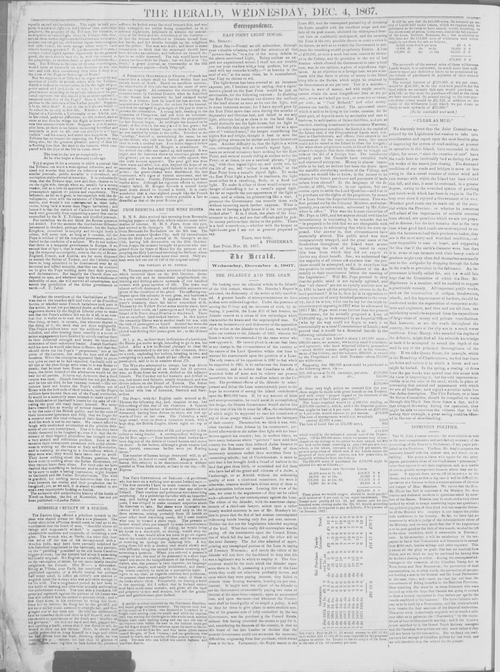
Edited Text
at g MRI Sw
THE HERALD, WEDNESDAY, DEC. 4, 1867.
Sila ii aa ma
= =e
dina ticitiees ra. 2 Pe ee eee.
app eel ctiniiinlepeinpii ditt Bitte a Monntonarmnmnmensinmenmrnennn
equally sacred and inviolable. Tho right to hold pro-
perty is a natural right; to bold this or that particalar)
property, the property of the Trilsune, for instance, is)
an acquired or vested fight. Does the Tribuae deny that,
udless these vested rights are hell sacred auc inviviable, |
society cannot get on, civilization lapses into savagun,
and talis lower, for even savage ives resp: cach!
other's hunting grounds? Hf, (in the course of events,) |
certain vested rights operate injuriously to the general:
ood, the most soviety may do, is, with the consent oi fate he so riclily deserved.
the proprietor, to ransom ihem, or give full indemnificn- |
tea, The Tribune in the ease of its owa vested rights,/Droit,” a grave journal, as trustwerthy as the
would insist as earnessly on this doctrine as any one Bailey sessions papers,—Daily Telegraph,
ean; and with what consistency then does it deny itan
the Gave of the Pope or Sovercign of Rome?
But we suppooe it of little use to argue seriously any
questiva of public or private ethies with the Tribune,
which is radical or conservative, helds the right of peor)
perey sacred and iavivlable or not, is tor of agains:
Lovernment according to its private interests or its per-
soval caprives: but why should it be so bitter against Ue
temporal authority of the Pope? Does it believe it in-
jurious to the interests of the Lalian people? Suppose
tly so, what then? Ik can in the well-kaown belief «f
its ediwor be su vuly in this life. Whether «a man is a
Vapist or a Calvinist, a Universalist or an Atheist, ean,
itwenty hours of death.
Correspondence,
cing tn tt EE te NR AE
sufferer, he kicked away the stool beneath him, and was
daly strangled, bis victim being compelled, as in a
hideous nigbtinare, helplessly to witness the> eonval- | —~-
rious of his limbs and the distortions of his features,—
ct ne Ml ty an
EAST POINT LIGHT HOUSE.
At last the woman Gontfived to liberate herself from
her boads, aod her shrieks brought up the neighhors| Mu. Retry:
and the police, The man was dead; and there is some! Dean Sax:—Permit an old subscriber, through.
ty ong to: think that the miscreant should have your valuable columns, to call the attention of the|
een his own executioner, aad inflicted on himself the ie powers that be,” to afew of the many defects in
biog he gam _ _ 5 the above mentioned Light, Being veither an ex-|
Ola pert nor experienced writer, I shall not not trouble|
\you nor your readers witha loug preface, but pro-
ceed with my remarks briefly,—** as brevity is the
A Frianrrve Occurrence ix Fraxce.—French law 80u! of wit,” at the same time, be it remembered,
enacts that a corpse shall be buried within four aad that I lay no claims to wit. :
Based on excellent motives,| ‘The light-house has been erected at an immense
the observance of this rule has been the cause of more expense, yet, I hesitate not in saying, that a signa!
than one tragedy, All remember the electrifying dis- lantern placed on the East Point would be just as
a by — gg gg be dlescribed serviceuble, for the following reasous: Ia doubling
i eo eee eaea pee our’ the East Point the mariver can discern the outlines,
while in a trance; how he heard the Iast service, the} x
lamentations of his friends, the orders for his funeral, of the land almost as soo as he can the light, and
jand how he managed to give signs of life just in time to in Some instances sooner, for | have myself gone by
prevent his inhumation, A young lady, residing in the the East Poiut more than once during the months of
commune of Plongeven, had not been so fortunate. September and October lust, and failed to see any
!
almost too incredible for Daute ;
aemeningas etim , e
im bis creed, make no difference, for life iv short, and as
woon as one dics be wings hiy flight to heaven aud en-
ters into inconevivable bliss.” Suppose a ura is miser-
able here, as there is no future reckoning hereafter and
beatitule is sure tu all, one can always by a *t bare
bodkin” ead his misery and cuter into happiness. The
Tribune has uo reason for opposing the Papacy or any
thing wlse, for the greatest possible misery of this lite
je Nothing loss than the dust in the balance, when com-
pared with the joys of the life to come, since
The best to-day are as completely so
As he who began a thousand years ago.
Yet it argues ill for a country in which a journal like
the Tribune can wield a wide-spread intluence, and we
need not wonder that under its influence and that of
similar journals, public morality is uadermined, and
vorruption stalks abroad at noonday. It is undoubtedly
true, that the Tribune may, now and then, chance to be
on the right side, though when so, usually for a wrong
reason, but as a rule ity approval of a cause is a strong
a against its justice and expediency, This
influence, as far as it goes, is incompatible with the de-
velopment, even with the existence of Christiana civil
zation, and would if not comnteracted b» other influ-
ences, bring back a worse than I’agan barbarism; and
hence it is that the instinct of Catholics has held them
back very generally from supporting a party that can be
controlled by the N. Y. Tribune and kindred journals.
For ourselves we do not think the Roman question
yet settled. For the moment the Garibaldian filibuster
movement is checked, perhaps defeated ; but the Italian
Kingdom, conceived in iniquity and brought forth in
crime, will never rest, so long as it remains, till the
Pope is robbed of all his gt possessions, and re-
duced to the condition of a subject, We do not believe
that there is » temporal government in Europe, if we
except that of vd that is really in favor of maintain-
ing the temporal suvereignity, even in the city of Rome.
England, France, and Austria, are far more disposed
to sustain the Sultan of Turkey, and the Catholic laity
have so long submitted to be domineered over by an
berotical and infidel minority, that they can be counted
on to give the Pope nothing more than their prayers
and declamations. But happily the Church does not
depend on man, and whatever may be the wickedness or
im ~~ of —_ o “ oy all catastrophes, and
Bassert the jurisdiction of the divine governmen
earth.—N, Y. Tublet. doe
Whether the overthrow of the Garibaldians at Tivoli
was due to the unaided skill and valor of the Pontifical
forces, or whether some French battalions took part in
the action, is not yet put beyond doubt, and the nervous
eagerness shown by the English Liberal press to make
vat that the Pope’s soldiers did not do it all, is so com-
ical that it warns us to wait for further information,—
One thing, at least, is certain, that whoever shared in
the doing of it, the work was not done negligently.
The Pope's soldiers have met the soldiers of the Re-
volution, and after beating them soundly in a score of
minor engagements have finished by iesly routing them
in their collected strength and under the immediate
commana of their redoubted leader. Joseph Garibaldi
told his men he would take them to Rome, and that they
should drive out the Pope's ‘* gargousians,” not at the
point of the bayonet, but with the butt end of their
muskets, When the enterprise appeared likely to prove
not quite so easy as be had expected, Garibaldi told us
all that at the pass things were come to it was Rome cr
death; that be must have Rome or die, and that, per-
haps, the latter branch of the alternative would be the
bes! for all parties. 1t turns out, however, that a third
course was open, Joseph Garibaldi has not got Rome,
and he has not died, he bas runaway instead.—Llis vol-
unteers have not beaten the Pope's soldiers out of
Rome with the butt ends of their muskets, but the Pope's
soldiers have huuted them out of the Papal territories.
It would be a miserably mean triumph to make sport of
the falsification of Garibaldi’s boasts for the sake of ridi-
caling the ~< old crazy fanatic himself. We never
have treated him as worthy of serious resentment. It
is for the sake of the British public, and for the cure of
their inveterate ignorance and folly, that we linger for
a moment over this total collapse of their fantastic idol.
And the work is not to our taste, We cannot afford to
Isugh with unallowed satisfaction at the pitiable delu-
sions of our own countrymen, True it is that they have
richly deserved to be laughed at; true it is that the ob-
stinacy of their bigoted prejudices has brought us into
a very absurd and ridiculous position. Lven at this
moment their newspapers persevere with stolid obtuse-
ness in writing up the cause ot Italy and Revolution,
and in insisting on sharing in a discomfitare which, il
they were wise, they would bave taken care to avoid.
They know nothing about the Roman question, they
know next to nothing about the Italian Revolution, yet
they cannot leave them alone. For their sake we bave
desired that ove ony 80 ludicrous and go striking as
to be sure to make a lasting impression, might happen
to Garibaldi and the Italian Revolutionists. The wish
is gratified, for wothing more ludicrous than the eon-
teast between the reality and their prophecies can be
imagined ; yet, as we said, it is almost sorrowtul to sec
one's own countrymen louking so foolish.
The authentic and authoritative history of the battle of
Tivoli on Sunday, the 3rd of November, bas not yet
deen published.—Zondon Tablet, .
HORRIBLE CRUELTY OF A SUICIDE,
The Eastern king offered a priccless reward to the
man who should invent for him a new pleasure. ‘The
latest chronicles of*crime would seem te lead us to the
wouclusion that the heart of man, ** deevitful above all
things and desperately wicked,” is capable, in its
abominable madness and poy nea of inventing a new
plan, The wretch why, at Derby, the other day, beat
the soles off the feet of his servant-inaid witha
wooden ladle, have been partially indebted for
iia diabolical inspiration to the bastinado, and partially
to the ** paddling” practised by the old South Cascinn
nigger-drivers; but the torture had about it something
infernally origmal. We English are excelled, however.
am the conveption of crime, by our wore fatally fanciful
bora, the French, One H , & Shoomaker,
Viving at Villete, near Paris, has contrived, with the
irverted ingenuity of @ wholly bestial but perhaps
fair erazy mind, to inflict an entire'y new epecies of
anguish u the woman who wat miserable enough to
tbe his wite. Fors lengthened period he had been in
the habit of beating and otherwisy brutally maltreatin
tho —— wretwh. - man was A peobart, his
prine’ tae against the partner of his hogeo was
that abe F used him the means to procure drink ; and a
faw days since, in hie endeavor to wring his booty
from her by torture, he flung ber to the groand, put
his kave on her chest, essayed to strangle her, and in
guyes one of ber eyes out. He told her deliberately
that he intended there and then to kill hiuself, and that
ebeshould be spectatress of his death and * shudder at
his .” Le tied her hand and feot, aaned her,
1g a knife, swore that if she dared to stir, he
cut hor Next, he slowly and
to hang bimeolf to a hage nail which
fe P, -ratione, :
J
w
ee
*
the pinioned
Within an hour of her supposed death, the preparations 4; : : i he fand that I
eg ine Rel hes ght, although beiag so close in to the tand that
for ber funeral began, At midfight she seemed te be! guid distinetly see the light-house, but no light in
lead ; at five o'clock she was p'aced in her grave; but ; * .
| when the sexton's belper pie A to throw inthe earth, its Probably this might be accounted for as a spes
jhe was startled by noises in the coflin, ‘Terrified at the les of * retrenchment,” the keeper cousideriug the
‘* prodigy,” instead 0 ascertaining the cause, he ran bights five aod bright, thought it best to save the
ty the rector, who told him first to get witnesses and light.giving elemeats for darker and more buisterous
_ to evek a era gg Five hours elapsed before ones. Another difficulty is, that the lightis a white
the summons reached M. Ronger, a practitioner, On : ot : , inks.
Als avvital he sala wae Meant | up and opened. It way OUe» Correspoucing with a vessel’s sigual light. 1
Loan Bill, and the consequent probability of obtaining!
the Loan, coupled with the excellent crops and mar-
kets of the past season, obviated the widespread finan-
cal ruin so confidently anticipated, and the securing
the Loan is the only possible chance to avert a crivis in
the future, as well as to enable the Government to pur-
chase the remaining unsold proprietory Estates, A loan
of £50,000, or even a much less sum, cannot be obtain-
ed in the Colony, and the provision in the act of last
Session which allowed the Government to raise a local
loan, was, in our opinion, a piece of superfluous legis-
lation. As an objection to a foreign loan, we are some-
times told that there is plenty of money in the Island”
lying idle in the Banks, which might be obtained by
the Government at six per cent. This is a mistake.
Parties in want of money, and with ample security,
cannot obtain the most insignificant loan at six per
cent., seven and a-half per cent., or even ten or twenty
per cent. as ‘Poor Richard,” and other money-
shavers can testify, if asked. The uninvested money
which is said to be lying in the banks, consists, for the
most part, of deposits made by mechanics and men in
business, in anticipation of future liabilities, and not, as
asserted, awaiting investment in Government Warrants,
|tity of Lands held under Leases, which
It will be seen that the 445,000 acres, the assumed qu an-
we ruppose may be
purchased at the rates. we have named, would, according to
the above scale of prices, in ten years, realize tne full amount
of the Loan, Interest, Expenses, &c.; but in addition to
this there are the 175,000 acres of wilderness land which
might be set down for sale as follows,
10,000 acres worth per acre oes
40,000 do do at Os 10,000 0 O
125,000 do do at 108 62,250 0 O
£72,250 0 0
The proceeds of the annual sales of these wilderness
Lands would, it is estimated, be much more than suffi-
cient to meet any deficieney likely to be occasioned by
the default of purchasers in payment of their annual
instalments,
The annual interest of £270,000, at six per cent,
would be £16,200; wile the rent now payable for the
land which we estimate this sum would purchase, is
£24,722; so that were the purchase eff-cted at the rates
we have mentioned, the annual saving to the rent-pay-
ers of the colony would be £8, 622, in addition to the
value of the wilderness land, which we put down as
likely to nett upwards of £70,000.”
(To be concluded next week.)
* CLEAR AS MUD.”
od
or other approved securities. So limited is the capital of; We sincerely trust that the Joint Committee ap-
the Island that, if the a of Lands were resi-
dent in Charlottetown, and offered their estates to the |Polated by the Ligislatare lust ression to take into
Government for the ready money down, the means cousideration aud report upon the most feasible plan
could not be raised m the Island to close the bargain ;'of improving the system of road-making
but when those proprictors reside in Great Britain, it is). P hy i os bak hae 8 | ilnseieeg
absurd to suppose that these claims can be bought out|!® operation in this Island, have succeeded in their
* the ex
while he wae purned to death, and a number of other persons severely in-
no jess than 15 glasses of jured. The man who was killed was named Sauce,” end
night, and the lanterns threw an uncertain gleam over:
the graves; yet nu sooner was the coflin opened, than
jthe truth became apparent. The poor girl was even
then warm and alive, bot, alas, beyond the hope of re-,
suscitation, She had struggled fiercely in her dreadful,
contracted,
body still warm.
buried alive. Although his vigurous efforts to restore
vitality failed, M. Rouger forbade a second burial
until death should be beyond a doubt.
h signs of violent movement, and the
do not repeal a law which ren¢
dreadful as that of the poor Breton girl.
FROM BERMUDA AND THE WEST INDIES.
——o
R. M.S, Delta arrived this morning from Bermuda;
mation of interest. H. M.S. Fawn, from this port,
had arrived at St. George's,
from Bermuda for Barbadoes on the 8th inst. The
American steamer Quaker City, with 62 excursionists
from the Holy Land, arrived at St. George's on the
llth, having left Alexandria on the 25th October.
From Joppa the steamer brought 42 persons who emi-
grated from the State of Maine for the purpose of re-
peopling the Holy Land and receiving the Saviour, whom
they believed would come some time since. Only six-
teen were left out out of 140 of the original colony.
THE TORNADO AT ST. TILOMAS,
St, Thomas papers contain accounts of the hurricane
which occurred there on the 20th October, devas-
— the city and its immediate neighborhood, dis-
masting and driving ashore upwards of one hundred
vessels, with great sacrifice of lifo. The town was
almost entircly destroyed, and deplorable accounts are
given of the condition of the place. The suffering con-
seqent upon this calamity is very great, and business is
in a very unsettled state, It appears that the Com-
any’s steamers, since the havoc committed at St.
prison; the tele Roegr were disordered, the feet)
w ul
Plainly, Philomene Jouetra bad been) cither be a revolving, flash, or # fixed red,
It is really)
wonderful that a clear-sighted i — the ~~
ers possible a fate so.
bringing papers of late date, which contain some infor- jig money perforin their duties to the public, There
HL. M. 8. Gannet sailed #8 & fault somewh cre,—vw hether with the keeper or
have on several occasions baen osking for the East
Poiat, and several vessels riding at auchor under the
Point, or at times, to use a nautical phrase, * jogg-
iog,” with their signal lights up, and could not, for
the life of me, tell *“tother from which,” or the
East Point from a vessel’s sigual light. To make
the East Poiut light a benefit to mariners, the light
hight. To make it either of these would remove the
danger of mistaking it for a vessel's signal light.
As far as regards the non-appearauce of the light at
times, and at others, its glimmering like a star, I
presume the Government can remedy (hose evils)
without incurring much further expense, Whiat is
the use of having a light house if it be ot properly
looked after? It is, 1 think, the place of the Gov-
ernment to do so, and see that officials paid by pub-
light-luuse gear I am not at present prepared to
say,
Yours, very truly,
A FISHERMAN,
East Point, Nov. 29, 1867.
Wednesday, December -1, 1807.
THE ISLANDER AND THE LOAN.
oes ———e —s
On looking over the editorial article in the Jslander
of the 15th instant, wherein Mr. Ilensley's Report is
criticised, the dishonesty of the writer 1s fully manifest-
ed. A greater bundle of misrepresentations we have
seldom seen collected together. Under the pretence of
homas by the Yellow Fever some months siace, have!
received their coals, an! passengers and freight at the!
Island of St Peter, about 20 miles to windward. There,
was an excellent land-locked harbor.
the steamship Rhone was at anchor ready for sea, with
the bulk of passengers on board, Around her were the
Solent, Tyne, and Wye, which vessels bad not yet com-
pleted transferring their passer gers, &e., to the ill-fated
‘hone,
Ati, p. m., as there were indications of a hurricane,
j
failed. After a few ineffectual atteinpts to clear the
bay, she succumbed to the fury of the elements, drove
on a rock, exploding her boilers, breaking in two, and
consigning to a speedy death all ber officers, crew and
passengers, said to be in number about 275.
The Wye also attempted to escape, but was driven
on the reefs, drowning all on board but 13 persons,
who, on floats from the wreck, drifted to the adjacent
Islands. The Conway cut her hawsers. and drifted to)
sea, lost masts and funnels, nearly foundered, and was,
driven ashore on the Island of ‘Tortola. The Solent,
and Tyne rode out the gale, the former without damage,
the latter with loss of foremast, Steward and Stew-
ardess.
The Douro, with the English mails. arrived at St.
Thomas the following day, and, singular to say, had
felt nothing of this war of the elements. A Spanish
war steamer in the harbor 1s described as shattered and
dismasted, having been driven on shore, she lost up-
wards of forty ot her crew, ‘The Columbia, a very
large vessel, went on shore a complete wreck, witha
huge ship, the British Empire, blown right on top of
her.
On skore, the destruction of life and property is des-
cribed as being fearful. A correspondent writing on
the 8d Nov, says:—** Four hundred dead bodies have
been dug out of the debris of ruined houses and stores
on shore. Inthe harbor, althougha great number had
been buried, numerous bodies were yet floating
about,”
The number of human beings destroyed will, in all
probability, be found to reach 1000, Altogether, it is
eared, this calamity in its destructiveness is without
parallel in West India annals, at least in our day.—J/z.
Express.
Tae True Gextirroik or Inntanp.—A gentleman
who has been on a walking tour around Ireland says :—
‘* The first remarks I have to make concern the peas-
antry, the class of whom I saw more than any other in
{reland. Their courtesy and politeness were something
vee egg G As a pedestrian traveller with an imperfect
map, and finding few mile-stones and no direction
posts, T was obliged to make constant enquiries about
the direction to take. But these were invariably an-
swered with cheertul readiness, and only in two or
three mstances, arising probably from ill health or
some other local disturbing cause, did I ever receive
what inay be termed a short reply, The peasant or
farmer would often put himself to some inconvenience
to answer one's questions, If viding, he would bring
his horse to a stand-still, or driving, would stop the
vehicle. A man would allow his team to go on regard-
less of the trouble of overtaking them, and be surprised
at receiving an apology for delaying him. boy
going down hill with a donkey cart would slowly and
with difficulty bring the animal to before receiving and
answering a question, When you entered a peasant’s
cottage or hut, the soul of its possessor in a short time
raised One above thy insignificance of his dwelling. In
dialect, also, the Herein very superior, his language
being pure, simple, and easily understood, and swear-
ing seems scarcely to exist as a perceptible habit, 1
regret to way that, as regards courtesy and politeness,
the peasant class seemed superior to many of those in
the ranks above them. Frequently, on Jeaving « hotel
in the morning, did I reflect that in Ireland nature
must have made some mistake, and given all the land
and property fo men and women, but left the gentle-
wan and gentlewoman poor indeed.
eee
A terrible accident occurred on the Cincinnat: Hamilton,
and Uroad guage railroad recently, The express train due
at Cincinnati at 6 o'clock, was detained at Lockland by a
freight train coming srom the south, and while the express
train was waiting for the freight to take a side track, another
freight train came sooing Sons and ran into the rear of
train before the man on the lookout could get
jout his fing to stopit. The collision upset the stove in the ex-
ese train, end set it on fire, and four ladies (three sisters
named Morgan, of New Orleans.) and one gentleman was
'
i
ij
In this harbor,
{
the Rhone got under weigh, intending to go to sea, but/now opposes it. He cannot plead in excuse that there
serving the Colony and the interests of truth, by de-
feating, if possible, the Loan Bill of last Session, the
Islander resorts to a series of low subterfuges which
characterise the knave and the unprincipled man. To
show the inconsistency and dishonesty of the opposition
of the writer in the Islander to the Loan, we need only
refer our readers to the Islander of 1861, wherein the
Loan is warmly recommended by the. same writer who
is any change in the circumstances of the country or
the nature of the Land Question within that time to
warrant his summersault upon the question of a Loan.
The only reasen of his opposition in 1867 to that which
he supported in 1861, is to embarrass the finances of
the country, and to induce the Canadians to offer a
wretched bribe of some sort to relieve our present
necessities, but to entail an endless misery on the Co-
lony. The persistent efforts of the Jslander to misre-
present and defeat the Loan unmistakeably point to the
hope he entertains of seeing the Island confederated
upon the $800,000 basis. If, by any amount of labor
and misrepresentation, be could assist in accomplishing
this design, the Ottawa Government would shelye him
for the rest of his life in some fat office, the emoluments
of which might be supposed to ease his conscience of
any of those pangs which usually haunt the betrayers
of their country. Themistocles, we think it was, who,
when banished from Athens by his countrymen, pre-
ferred afterwards to die rather than fight with his bene-
factors against his country; but, in modern times, we
have many instances where ‘' patriots” have sold their
country for less sums than induced Judas Iscariot to
betray the Redeemer of mankind. Many of these
mercenary monsters ended their worthless lives by
committing suicide; but of Confederation, it must be
said that it has brought forth a broed of traitors to the
land that gave them birth, or nourished and fed them
who have bad all the greed and vileness of a Judas, a
Castlereagh, or an Arnold, without the redeeming
quality of even a cicatrised conscience, for were it
otherwise, remorse would have driven many of them to
self-destruction before now. Leaving this view of the
case, we come to the arguments—if they can be called
auch—advanced by our contemporary against the Loan.
The editor of the Islander, with the smartness charac-
teristic of a third-rate lawyer, seizes upon a rather
loosely worded sentence in ons of Mr. Hensley’s let-
ters to prove that the Act of last session contemplated
redeeming bonds bearing only five per cent. interest.
Neither the Act nor the Legislature intended anything
of the kind, What they really did contemplate was the
paying off the instalments upon the Cunard Estate,
one of which fell due last July, and the other will be
due next January. The Act also admitted of appro.
priating any unemployed portion of the Loan in paying
off Treasury Warrants; ard surely the editor of the
Islander will not have the hardihood to deny that this
was a legitimate way in which to employ it. The Gov-
ernment would be the fools which the Jslander repre-
sents them to be, if, possessing a portion of the Loan
which they could not otherwise profitably invest, and
upon which they were paying interest, they failed to
redeem those floating warrants, bearing six per cent.
interest. It “might suit the object of the Islander to
see the Government unnecessarily paying two rates ot
interest at the sawe tine—namely, Upon an uninvested
loan, and upon warrants—but whenever the Govern-
ment shall be found guilty of so stupid a policy, it will
be time for them to give place to more sensible men.
One of the greatest acts of folly committed by the late
Government, was the purchasing the Cunard Estate,
without first having provided the means to pay for it,
and, considering the finances of the country, it was no
idle boast of the Jate Leader to declare that the
without the aid of a foreign loan. The instalments
already paid the Cunards have curtailed trade
and repressed eaterprise. Money is almost impos-
sible to be had, so serious lias been the drain upon
where, we should like to know, is the money to be
obtained for future purchases and payments of lands
unless from abroad? In the language of the Js-
lander, of 1861, ‘there is. in our opinion, but one
to purchase out the rights of the propietors, by meaus
of a Loan from the Iinperial Government, ‘This was
first pointed out by the Colovial Miuister, and subse-
quently, toa certain extent, advocated by Mr, Coles
when in office.” This was the honest conviction of
Mr. Pope iv 1861, and lest anyoue should twit him for
inconsistency in expressing it, he remarks that be
** is prepared to be told that we are chargeable with
inconsistency, in advocating that which we ouce op-
posed, Our answer is, that circumstances have
materially altered. ‘The public mind was then
comparatively tranquil, aud the great mass of the
freeholders throughout the Islaud were averse
to incurring the risk of being taxed to repay
this loan from which they did not expect to
derive any direct beuefit. Now, we understand that
the majority of all classes ure anxieua that the pur-
chase should be attempted, and it is expedient that
tha question be submitted by Members of the As-
sembly :o their constituents before the meeting of
thatthe public mind is not equally agitated, and
that all clasges’’ aro not a3 equally anxious now as
in 1861 to have all the proprietory estates in the Is-
luud purchased ? If he is, theo he is in opposition to
uinety-uine out of every hundred persons iu the coun-
try, but it he is not, what can be say for the triple in-
cousisteucy of opposing in 1867 what he advocated ia
1861? Mr. Pope went even further than the present
Government, tor he actually proposed a Loan of
£180,000 stg., to be managed by an Imperial Officer
(who by the way could not begin to werk it so
economically as a local Commissioner of Lands,) and
proved that it would be @ financial benefit by the
following calculations :—
«The area of the Island is about 1.340.000 acres—
600,000 aeres, we assume, are held by small frecholders,
and squatters, who have acquired titles by possession
—about $0,00) remain undisposed of in the Govern-
ment of the Colony, and the balance, 660,000, is owned
by the Proprietors and their Tenants—about 175,000
are wilderness,
Supposing that 620,000 acres could be purchased at
the following rates, vig :—
320, 000 acres at 7s 6d, currency, Der acre,
300,000 do at 10s do,
£120,000
150,000
£270,000
at these very high pricos we contend that the pur-
chose might be made with great benefit to the Tenants,
and with every ** proper regard to the interests of the
Inhabitarts of the Coleny generally.”
The Loaa required would be £180,000 sterling, or
£270,000 currency, which, under the Imperial guaran-
tee, might be had at 4 per cent. Interest on £270,000
at 4 per cent, would amount to, per annum, £10,600
The cost of management would not, we submit,
exceed £2,000 a year, 2,000
The loss of Laud Tax on 175,000 acres, 800
In all £138,600
which would be the estimated annual cost of the Depart-
ment. Of the 620.000 acres, which we assume may be pur-
are held under leases reserving Is, plus 1-9th per acre rent,
which, in the whole, amounts to £24,722 per annum, the
greater proportion of which will, if the Lands remain the
property of their present owners, ina few years time, be
annpally withdrawn from the Colony.
‘The 620,000 acres, if purchased for £270,000 might be
allotted for sale as follows ;—
Leasey axv Occerizy Lanne,
45,000 acres at 7s. 6d, £16,875 0 @
60,000 do at 19s, 26,000 0 0
275,000 do at 12s. 6d, 171,875 0:0
76,000 do at lis, 66,260 0 0
These prices we would suggest, should be made payab!e
with interest at 6 per cent, in ten equal instalments. ‘The
Tenant now paying £6 11s 2d, per annum rent for one
hundred acres, coming under the 12s. 64, would, according
to this scale, be required to pay as follows, if he purcase on
tet January, 1862:
~ wowovovoe | ©
S$ NM OAOroN t
ian — se - Sl £
on
grererrrs we
, eeoeovorcv | &
Bs PoNneronyr |
a — ae ~ _
$3 adhd t ap ca laa ©
ane w
s eocooooeco
i=]
°
: Zw Oowon
Seo wise Nw
RB eeRsSaaaae
5S ew
= s
°
A 6MSESS ESSE
Sececocooosoo , 56
6 Oi 1919 HH HIG | ©
pee ooo
3% eecee 3
@68ceé Seshan
GIES SST CSTs
mSuvtsssess
“RaESSSRSH5
Ssseeeeees
SES eenenne
ee ee ee et ee
an
Ssssessess
ot et ed et ed et et et et
Ten year's Rent at £6 11 2d would amount to £55 11 8d,
present Government could not surmount the monetary
thom in the face. Fortanately, the Royal assent to the
Pale from Boston,
at the rate of 125 6d currency per acre,
the metallic circulating medium of the Colony, and
course open to settle the Land Question—and that is!
the Legislature.” Will Mr. Pope pretend to deny)
chased on the average at the prices we have named, 445,000,
object, for never, ** since the creation of cata” have
the roads been sq iutolerably bad as during the past
six weeks of the season just closing, ‘The damaged
condition of our roads and bridges is more or less
lowing to. the ususual number of violent wind and
rain storms with which the Island has been visited
this fall, and also, it must be confessed, in a greater
degree, owing to the wretched aystem of patching
jand boteh-work which has been in vogue in the Co-
lony ever since it enjoyed a Government of ils own,
Whether good roads can be made out of the mate-
rial within the Province, or whether its resources
will admit efthe importation of suitable material
from abroad, are questions which we are vot prepa-
red to discuss, but the fact remaius that at the very
time when good hard roads are most required to en.
jable the farmers to haul their produce to maket, they
are in the most sorry aud wretched condition, —al-
most impassible to man or boast, and suggesting
ithe idea that if the earth's diameter were less than
jit iv, some of our farmors with their heavy ioads of
\produce might very often find themselves summarily
pit to the antipodes by dropping through the holes
in the roads so prevalent io the fallseason, An im-
|provement is loudly called for, and we would faiu
hope that the Committee of which tle Hon. Mr.
| Haythorne is a member, will be enabled to sugyest
: practicable remedy, Allimportaut publie works,
such as the coustruction of oridges, breakwaters,
wharfs, avd the improvement of harbors, should be
leooducted under the supervision of competent archi-
tects and engineers, and then and not till then, can
satisfactory results beexpecied from the expeuditure
jof large sums of money and private contributions.
Bad, however, as are the roads throughout the
country, the streets o! the city are in a much worse
condition. Lieut. Maury, who sounded the depths of
the Atlantic, might find all his scieutific knowledge
at fault if he attempted to sound the depth of the
mud in avy of the principal thoroughfares of the
icity. If we take Queeo Street, for example, which
is the Broadway of Charlottetowu, we find that there
arc holes and ruts in it iu which a horse avd cart
might be buried. In the spring, a coating ot dross
;from the gas works was spread over this street with
jthe view of improving it, but the only improvemanc
|visible is ia the color of the mud, which, in place of
possessing that natural red appearance with which
;we are all familiar, now eajoys a peculiar sable hoo
ithat defies description, ‘The City Fathers, or at least
\the Street Committee, should be compelled to wade
jthrough this Black Sea three times a day, and it
ithey eSeaped drowning during the operation, they
jmight be able to couvinge the citizens that by fol-
lowing their example, a great saving could be effeet-
ed in the use of shoe-blacking.
DOMINION POLITICS,
|
|
Ao ee a a A eee ee RR
Tur St. John Jreonan contains the most reliable as well
as the most comprehensive and satisfactory summary of the
| proceedings of the Dominicn Parliament, of any paper pub-
jlished in the Provinces, ‘The lion. Mr. Anglin prepares the
summary himself with the utmost eare, and hence its re-
liability, The penny-a-liners who report for tho other
papers, particularly those of the Confoderate ** persuasion,”
color their reports to suit their employers, and, as a matter
of course, grossly misrepresent those to whom they are in-
imieal. It appears there are no oficial reporters to the
House, and so long as this is the case it will be diMeult for
spectators at a distanve to form a correct estimate of the tone
and temper of Ion, Members. We notice that the Hoa.
£270,000 0 0 AMr. Howe has had to reprimand the Ministry for thoir
evasive and dishonest answers to questions asked by mem-
bers of the Heuse. Evasion may be coasi.ered a vory clever
method by whieh to escape answering impor tant questions ;
but political jugglery of that kind will not raise the charac-
ter of the Minister who employs it, nor inspire the public
with confidence in his honesty. 8o far, we have had no
measures by which to judge of the Administrative talont of
the Ministry, and we very much fear that if the Legislature
1s to be prorogued on the 10th of this month, we shall be left
in the same condition, until it reassembles in February
next. In the meantime st will bo satisfaetory to the tax-
payers to know that Commoners and Senators he ve earned
their $600 each, besides mileage and other expenses, This
is about all the glory or prefit that has yet resulted from
Union, and we think we may be pardoned for having thus
far declined sharing in either. « Ansong the contemplated ad-
vantages is the extension of the Canadian Stamp Act to
Nova Scotia and New Brunswick; the prevention of dual
representation, or, in other words, the prevention of one per-
son holding a seat in the Goneral and the Local Parliament
at the same time; and—mark ye—-lnst, bat not least, the
non-extension of fishing bountles to the Maritime Provinces,
How consoling this must bo to those fishermen who were
buoyed up with the hope that Canada was going to extend
to them a bounty equivalent to four dollars per tgn for the
vessels employed in the business ! The Inter-Colonial rail-
way is to be built by a Commission, and the reute selected
isto receive the final sanction of the Imperial authorities,
This great work is absolutely required, not so much a mili-
tary adfair as to galvanize the “ Nationality’ by the expen-
diture of four million pounds sterling; and if the Country
had not enriched by it, the Grand Trunk Railway managers
and the Canadian wire-pullers are very much belied if they
will not fatten by the transaction, But we fancy our read-
: i 410d of t) i the proposed
difficulties, originating from that purchase, which stared leshemwe 00 on dy a * Sais wae te sue of lie dar im, (ers have had enough of Canadian politics for one week, and
we will therefore drop the subject for the present.
‘
THE HERALD, WEDNESDAY, DEC. 4, 1867.
Sila ii aa ma
= =e
dina ticitiees ra. 2 Pe ee eee.
app eel ctiniiinlepeinpii ditt Bitte a Monntonarmnmnmensinmenmrnennn
equally sacred and inviolable. Tho right to hold pro-
perty is a natural right; to bold this or that particalar)
property, the property of the Trilsune, for instance, is)
an acquired or vested fight. Does the Tribuae deny that,
udless these vested rights are hell sacred auc inviviable, |
society cannot get on, civilization lapses into savagun,
and talis lower, for even savage ives resp: cach!
other's hunting grounds? Hf, (in the course of events,) |
certain vested rights operate injuriously to the general:
ood, the most soviety may do, is, with the consent oi fate he so riclily deserved.
the proprietor, to ransom ihem, or give full indemnificn- |
tea, The Tribune in the ease of its owa vested rights,/Droit,” a grave journal, as trustwerthy as the
would insist as earnessly on this doctrine as any one Bailey sessions papers,—Daily Telegraph,
ean; and with what consistency then does it deny itan
the Gave of the Pope or Sovercign of Rome?
But we suppooe it of little use to argue seriously any
questiva of public or private ethies with the Tribune,
which is radical or conservative, helds the right of peor)
perey sacred and iavivlable or not, is tor of agains:
Lovernment according to its private interests or its per-
soval caprives: but why should it be so bitter against Ue
temporal authority of the Pope? Does it believe it in-
jurious to the interests of the Lalian people? Suppose
tly so, what then? Ik can in the well-kaown belief «f
its ediwor be su vuly in this life. Whether «a man is a
Vapist or a Calvinist, a Universalist or an Atheist, ean,
itwenty hours of death.
Correspondence,
cing tn tt EE te NR AE
sufferer, he kicked away the stool beneath him, and was
daly strangled, bis victim being compelled, as in a
hideous nigbtinare, helplessly to witness the> eonval- | —~-
rious of his limbs and the distortions of his features,—
ct ne Ml ty an
EAST POINT LIGHT HOUSE.
At last the woman Gontfived to liberate herself from
her boads, aod her shrieks brought up the neighhors| Mu. Retry:
and the police, The man was dead; and there is some! Dean Sax:—Permit an old subscriber, through.
ty ong to: think that the miscreant should have your valuable columns, to call the attention of the|
een his own executioner, aad inflicted on himself the ie powers that be,” to afew of the many defects in
biog he gam _ _ 5 the above mentioned Light, Being veither an ex-|
Ola pert nor experienced writer, I shall not not trouble|
\you nor your readers witha loug preface, but pro-
ceed with my remarks briefly,—** as brevity is the
A Frianrrve Occurrence ix Fraxce.—French law 80u! of wit,” at the same time, be it remembered,
enacts that a corpse shall be buried within four aad that I lay no claims to wit. :
Based on excellent motives,| ‘The light-house has been erected at an immense
the observance of this rule has been the cause of more expense, yet, I hesitate not in saying, that a signa!
than one tragedy, All remember the electrifying dis- lantern placed on the East Point would be just as
a by — gg gg be dlescribed serviceuble, for the following reasous: Ia doubling
i eo eee eaea pee our’ the East Point the mariver can discern the outlines,
while in a trance; how he heard the Iast service, the} x
lamentations of his friends, the orders for his funeral, of the land almost as soo as he can the light, and
jand how he managed to give signs of life just in time to in Some instances sooner, for | have myself gone by
prevent his inhumation, A young lady, residing in the the East Poiut more than once during the months of
commune of Plongeven, had not been so fortunate. September and October lust, and failed to see any
!
almost too incredible for Daute ;
aemeningas etim , e
im bis creed, make no difference, for life iv short, and as
woon as one dics be wings hiy flight to heaven aud en-
ters into inconevivable bliss.” Suppose a ura is miser-
able here, as there is no future reckoning hereafter and
beatitule is sure tu all, one can always by a *t bare
bodkin” ead his misery and cuter into happiness. The
Tribune has uo reason for opposing the Papacy or any
thing wlse, for the greatest possible misery of this lite
je Nothing loss than the dust in the balance, when com-
pared with the joys of the life to come, since
The best to-day are as completely so
As he who began a thousand years ago.
Yet it argues ill for a country in which a journal like
the Tribune can wield a wide-spread intluence, and we
need not wonder that under its influence and that of
similar journals, public morality is uadermined, and
vorruption stalks abroad at noonday. It is undoubtedly
true, that the Tribune may, now and then, chance to be
on the right side, though when so, usually for a wrong
reason, but as a rule ity approval of a cause is a strong
a against its justice and expediency, This
influence, as far as it goes, is incompatible with the de-
velopment, even with the existence of Christiana civil
zation, and would if not comnteracted b» other influ-
ences, bring back a worse than I’agan barbarism; and
hence it is that the instinct of Catholics has held them
back very generally from supporting a party that can be
controlled by the N. Y. Tribune and kindred journals.
For ourselves we do not think the Roman question
yet settled. For the moment the Garibaldian filibuster
movement is checked, perhaps defeated ; but the Italian
Kingdom, conceived in iniquity and brought forth in
crime, will never rest, so long as it remains, till the
Pope is robbed of all his gt possessions, and re-
duced to the condition of a subject, We do not believe
that there is » temporal government in Europe, if we
except that of vd that is really in favor of maintain-
ing the temporal suvereignity, even in the city of Rome.
England, France, and Austria, are far more disposed
to sustain the Sultan of Turkey, and the Catholic laity
have so long submitted to be domineered over by an
berotical and infidel minority, that they can be counted
on to give the Pope nothing more than their prayers
and declamations. But happily the Church does not
depend on man, and whatever may be the wickedness or
im ~~ of —_ o “ oy all catastrophes, and
Bassert the jurisdiction of the divine governmen
earth.—N, Y. Tublet. doe
Whether the overthrow of the Garibaldians at Tivoli
was due to the unaided skill and valor of the Pontifical
forces, or whether some French battalions took part in
the action, is not yet put beyond doubt, and the nervous
eagerness shown by the English Liberal press to make
vat that the Pope’s soldiers did not do it all, is so com-
ical that it warns us to wait for further information,—
One thing, at least, is certain, that whoever shared in
the doing of it, the work was not done negligently.
The Pope's soldiers have met the soldiers of the Re-
volution, and after beating them soundly in a score of
minor engagements have finished by iesly routing them
in their collected strength and under the immediate
commana of their redoubted leader. Joseph Garibaldi
told his men he would take them to Rome, and that they
should drive out the Pope's ‘* gargousians,” not at the
point of the bayonet, but with the butt end of their
muskets, When the enterprise appeared likely to prove
not quite so easy as be had expected, Garibaldi told us
all that at the pass things were come to it was Rome cr
death; that be must have Rome or die, and that, per-
haps, the latter branch of the alternative would be the
bes! for all parties. 1t turns out, however, that a third
course was open, Joseph Garibaldi has not got Rome,
and he has not died, he bas runaway instead.—Llis vol-
unteers have not beaten the Pope's soldiers out of
Rome with the butt ends of their muskets, but the Pope's
soldiers have huuted them out of the Papal territories.
It would be a miserably mean triumph to make sport of
the falsification of Garibaldi’s boasts for the sake of ridi-
caling the ~< old crazy fanatic himself. We never
have treated him as worthy of serious resentment. It
is for the sake of the British public, and for the cure of
their inveterate ignorance and folly, that we linger for
a moment over this total collapse of their fantastic idol.
And the work is not to our taste, We cannot afford to
Isugh with unallowed satisfaction at the pitiable delu-
sions of our own countrymen, True it is that they have
richly deserved to be laughed at; true it is that the ob-
stinacy of their bigoted prejudices has brought us into
a very absurd and ridiculous position. Lven at this
moment their newspapers persevere with stolid obtuse-
ness in writing up the cause ot Italy and Revolution,
and in insisting on sharing in a discomfitare which, il
they were wise, they would bave taken care to avoid.
They know nothing about the Roman question, they
know next to nothing about the Italian Revolution, yet
they cannot leave them alone. For their sake we bave
desired that ove ony 80 ludicrous and go striking as
to be sure to make a lasting impression, might happen
to Garibaldi and the Italian Revolutionists. The wish
is gratified, for wothing more ludicrous than the eon-
teast between the reality and their prophecies can be
imagined ; yet, as we said, it is almost sorrowtul to sec
one's own countrymen louking so foolish.
The authentic and authoritative history of the battle of
Tivoli on Sunday, the 3rd of November, bas not yet
deen published.—Zondon Tablet, .
HORRIBLE CRUELTY OF A SUICIDE,
The Eastern king offered a priccless reward to the
man who should invent for him a new pleasure. ‘The
latest chronicles of*crime would seem te lead us to the
wouclusion that the heart of man, ** deevitful above all
things and desperately wicked,” is capable, in its
abominable madness and poy nea of inventing a new
plan, The wretch why, at Derby, the other day, beat
the soles off the feet of his servant-inaid witha
wooden ladle, have been partially indebted for
iia diabolical inspiration to the bastinado, and partially
to the ** paddling” practised by the old South Cascinn
nigger-drivers; but the torture had about it something
infernally origmal. We English are excelled, however.
am the conveption of crime, by our wore fatally fanciful
bora, the French, One H , & Shoomaker,
Viving at Villete, near Paris, has contrived, with the
irverted ingenuity of @ wholly bestial but perhaps
fair erazy mind, to inflict an entire'y new epecies of
anguish u the woman who wat miserable enough to
tbe his wite. Fors lengthened period he had been in
the habit of beating and otherwisy brutally maltreatin
tho —— wretwh. - man was A peobart, his
prine’ tae against the partner of his hogeo was
that abe F used him the means to procure drink ; and a
faw days since, in hie endeavor to wring his booty
from her by torture, he flung ber to the groand, put
his kave on her chest, essayed to strangle her, and in
guyes one of ber eyes out. He told her deliberately
that he intended there and then to kill hiuself, and that
ebeshould be spectatress of his death and * shudder at
his .” Le tied her hand and feot, aaned her,
1g a knife, swore that if she dared to stir, he
cut hor Next, he slowly and
to hang bimeolf to a hage nail which
fe P, -ratione, :
J
w
ee
*
the pinioned
Within an hour of her supposed death, the preparations 4; : : i he fand that I
eg ine Rel hes ght, although beiag so close in to the tand that
for ber funeral began, At midfight she seemed te be! guid distinetly see the light-house, but no light in
lead ; at five o'clock she was p'aced in her grave; but ; * .
| when the sexton's belper pie A to throw inthe earth, its Probably this might be accounted for as a spes
jhe was startled by noises in the coflin, ‘Terrified at the les of * retrenchment,” the keeper cousideriug the
‘* prodigy,” instead 0 ascertaining the cause, he ran bights five aod bright, thought it best to save the
ty the rector, who told him first to get witnesses and light.giving elemeats for darker and more buisterous
_ to evek a era gg Five hours elapsed before ones. Another difficulty is, that the lightis a white
the summons reached M. Ronger, a practitioner, On : ot : , inks.
Als avvital he sala wae Meant | up and opened. It way OUe» Correspoucing with a vessel’s sigual light. 1
Loan Bill, and the consequent probability of obtaining!
the Loan, coupled with the excellent crops and mar-
kets of the past season, obviated the widespread finan-
cal ruin so confidently anticipated, and the securing
the Loan is the only possible chance to avert a crivis in
the future, as well as to enable the Government to pur-
chase the remaining unsold proprietory Estates, A loan
of £50,000, or even a much less sum, cannot be obtain-
ed in the Colony, and the provision in the act of last
Session which allowed the Government to raise a local
loan, was, in our opinion, a piece of superfluous legis-
lation. As an objection to a foreign loan, we are some-
times told that there is plenty of money in the Island”
lying idle in the Banks, which might be obtained by
the Government at six per cent. This is a mistake.
Parties in want of money, and with ample security,
cannot obtain the most insignificant loan at six per
cent., seven and a-half per cent., or even ten or twenty
per cent. as ‘Poor Richard,” and other money-
shavers can testify, if asked. The uninvested money
which is said to be lying in the banks, consists, for the
most part, of deposits made by mechanics and men in
business, in anticipation of future liabilities, and not, as
asserted, awaiting investment in Government Warrants,
|tity of Lands held under Leases, which
It will be seen that the 445,000 acres, the assumed qu an-
we ruppose may be
purchased at the rates. we have named, would, according to
the above scale of prices, in ten years, realize tne full amount
of the Loan, Interest, Expenses, &c.; but in addition to
this there are the 175,000 acres of wilderness land which
might be set down for sale as follows,
10,000 acres worth per acre oes
40,000 do do at Os 10,000 0 O
125,000 do do at 108 62,250 0 O
£72,250 0 0
The proceeds of the annual sales of these wilderness
Lands would, it is estimated, be much more than suffi-
cient to meet any deficieney likely to be occasioned by
the default of purchasers in payment of their annual
instalments,
The annual interest of £270,000, at six per cent,
would be £16,200; wile the rent now payable for the
land which we estimate this sum would purchase, is
£24,722; so that were the purchase eff-cted at the rates
we have mentioned, the annual saving to the rent-pay-
ers of the colony would be £8, 622, in addition to the
value of the wilderness land, which we put down as
likely to nett upwards of £70,000.”
(To be concluded next week.)
* CLEAR AS MUD.”
od
or other approved securities. So limited is the capital of; We sincerely trust that the Joint Committee ap-
the Island that, if the a of Lands were resi-
dent in Charlottetown, and offered their estates to the |Polated by the Ligislatare lust ression to take into
Government for the ready money down, the means cousideration aud report upon the most feasible plan
could not be raised m the Island to close the bargain ;'of improving the system of road-making
but when those proprictors reside in Great Britain, it is). P hy i os bak hae 8 | ilnseieeg
absurd to suppose that these claims can be bought out|!® operation in this Island, have succeeded in their
* the ex
while he wae purned to death, and a number of other persons severely in-
no jess than 15 glasses of jured. The man who was killed was named Sauce,” end
night, and the lanterns threw an uncertain gleam over:
the graves; yet nu sooner was the coflin opened, than
jthe truth became apparent. The poor girl was even
then warm and alive, bot, alas, beyond the hope of re-,
suscitation, She had struggled fiercely in her dreadful,
contracted,
body still warm.
buried alive. Although his vigurous efforts to restore
vitality failed, M. Rouger forbade a second burial
until death should be beyond a doubt.
h signs of violent movement, and the
do not repeal a law which ren¢
dreadful as that of the poor Breton girl.
FROM BERMUDA AND THE WEST INDIES.
——o
R. M.S, Delta arrived this morning from Bermuda;
mation of interest. H. M.S. Fawn, from this port,
had arrived at St. George's,
from Bermuda for Barbadoes on the 8th inst. The
American steamer Quaker City, with 62 excursionists
from the Holy Land, arrived at St. George's on the
llth, having left Alexandria on the 25th October.
From Joppa the steamer brought 42 persons who emi-
grated from the State of Maine for the purpose of re-
peopling the Holy Land and receiving the Saviour, whom
they believed would come some time since. Only six-
teen were left out out of 140 of the original colony.
THE TORNADO AT ST. TILOMAS,
St, Thomas papers contain accounts of the hurricane
which occurred there on the 20th October, devas-
— the city and its immediate neighborhood, dis-
masting and driving ashore upwards of one hundred
vessels, with great sacrifice of lifo. The town was
almost entircly destroyed, and deplorable accounts are
given of the condition of the place. The suffering con-
seqent upon this calamity is very great, and business is
in a very unsettled state, It appears that the Com-
any’s steamers, since the havoc committed at St.
prison; the tele Roegr were disordered, the feet)
w ul
Plainly, Philomene Jouetra bad been) cither be a revolving, flash, or # fixed red,
It is really)
wonderful that a clear-sighted i — the ~~
ers possible a fate so.
bringing papers of late date, which contain some infor- jig money perforin their duties to the public, There
HL. M. 8. Gannet sailed #8 & fault somewh cre,—vw hether with the keeper or
have on several occasions baen osking for the East
Poiat, and several vessels riding at auchor under the
Point, or at times, to use a nautical phrase, * jogg-
iog,” with their signal lights up, and could not, for
the life of me, tell *“tother from which,” or the
East Point from a vessel’s sigual light. To make
the East Poiut light a benefit to mariners, the light
hight. To make it either of these would remove the
danger of mistaking it for a vessel's signal light.
As far as regards the non-appearauce of the light at
times, and at others, its glimmering like a star, I
presume the Government can remedy (hose evils)
without incurring much further expense, Whiat is
the use of having a light house if it be ot properly
looked after? It is, 1 think, the place of the Gov-
ernment to do so, and see that officials paid by pub-
light-luuse gear I am not at present prepared to
say,
Yours, very truly,
A FISHERMAN,
East Point, Nov. 29, 1867.
Wednesday, December -1, 1807.
THE ISLANDER AND THE LOAN.
oes ———e —s
On looking over the editorial article in the Jslander
of the 15th instant, wherein Mr. Ilensley's Report is
criticised, the dishonesty of the writer 1s fully manifest-
ed. A greater bundle of misrepresentations we have
seldom seen collected together. Under the pretence of
homas by the Yellow Fever some months siace, have!
received their coals, an! passengers and freight at the!
Island of St Peter, about 20 miles to windward. There,
was an excellent land-locked harbor.
the steamship Rhone was at anchor ready for sea, with
the bulk of passengers on board, Around her were the
Solent, Tyne, and Wye, which vessels bad not yet com-
pleted transferring their passer gers, &e., to the ill-fated
‘hone,
Ati, p. m., as there were indications of a hurricane,
j
failed. After a few ineffectual atteinpts to clear the
bay, she succumbed to the fury of the elements, drove
on a rock, exploding her boilers, breaking in two, and
consigning to a speedy death all ber officers, crew and
passengers, said to be in number about 275.
The Wye also attempted to escape, but was driven
on the reefs, drowning all on board but 13 persons,
who, on floats from the wreck, drifted to the adjacent
Islands. The Conway cut her hawsers. and drifted to)
sea, lost masts and funnels, nearly foundered, and was,
driven ashore on the Island of ‘Tortola. The Solent,
and Tyne rode out the gale, the former without damage,
the latter with loss of foremast, Steward and Stew-
ardess.
The Douro, with the English mails. arrived at St.
Thomas the following day, and, singular to say, had
felt nothing of this war of the elements. A Spanish
war steamer in the harbor 1s described as shattered and
dismasted, having been driven on shore, she lost up-
wards of forty ot her crew, ‘The Columbia, a very
large vessel, went on shore a complete wreck, witha
huge ship, the British Empire, blown right on top of
her.
On skore, the destruction of life and property is des-
cribed as being fearful. A correspondent writing on
the 8d Nov, says:—** Four hundred dead bodies have
been dug out of the debris of ruined houses and stores
on shore. Inthe harbor, althougha great number had
been buried, numerous bodies were yet floating
about,”
The number of human beings destroyed will, in all
probability, be found to reach 1000, Altogether, it is
eared, this calamity in its destructiveness is without
parallel in West India annals, at least in our day.—J/z.
Express.
Tae True Gextirroik or Inntanp.—A gentleman
who has been on a walking tour around Ireland says :—
‘* The first remarks I have to make concern the peas-
antry, the class of whom I saw more than any other in
{reland. Their courtesy and politeness were something
vee egg G As a pedestrian traveller with an imperfect
map, and finding few mile-stones and no direction
posts, T was obliged to make constant enquiries about
the direction to take. But these were invariably an-
swered with cheertul readiness, and only in two or
three mstances, arising probably from ill health or
some other local disturbing cause, did I ever receive
what inay be termed a short reply, The peasant or
farmer would often put himself to some inconvenience
to answer one's questions, If viding, he would bring
his horse to a stand-still, or driving, would stop the
vehicle. A man would allow his team to go on regard-
less of the trouble of overtaking them, and be surprised
at receiving an apology for delaying him. boy
going down hill with a donkey cart would slowly and
with difficulty bring the animal to before receiving and
answering a question, When you entered a peasant’s
cottage or hut, the soul of its possessor in a short time
raised One above thy insignificance of his dwelling. In
dialect, also, the Herein very superior, his language
being pure, simple, and easily understood, and swear-
ing seems scarcely to exist as a perceptible habit, 1
regret to way that, as regards courtesy and politeness,
the peasant class seemed superior to many of those in
the ranks above them. Frequently, on Jeaving « hotel
in the morning, did I reflect that in Ireland nature
must have made some mistake, and given all the land
and property fo men and women, but left the gentle-
wan and gentlewoman poor indeed.
eee
A terrible accident occurred on the Cincinnat: Hamilton,
and Uroad guage railroad recently, The express train due
at Cincinnati at 6 o'clock, was detained at Lockland by a
freight train coming srom the south, and while the express
train was waiting for the freight to take a side track, another
freight train came sooing Sons and ran into the rear of
train before the man on the lookout could get
jout his fing to stopit. The collision upset the stove in the ex-
ese train, end set it on fire, and four ladies (three sisters
named Morgan, of New Orleans.) and one gentleman was
'
i
ij
In this harbor,
{
the Rhone got under weigh, intending to go to sea, but/now opposes it. He cannot plead in excuse that there
serving the Colony and the interests of truth, by de-
feating, if possible, the Loan Bill of last Session, the
Islander resorts to a series of low subterfuges which
characterise the knave and the unprincipled man. To
show the inconsistency and dishonesty of the opposition
of the writer in the Islander to the Loan, we need only
refer our readers to the Islander of 1861, wherein the
Loan is warmly recommended by the. same writer who
is any change in the circumstances of the country or
the nature of the Land Question within that time to
warrant his summersault upon the question of a Loan.
The only reasen of his opposition in 1867 to that which
he supported in 1861, is to embarrass the finances of
the country, and to induce the Canadians to offer a
wretched bribe of some sort to relieve our present
necessities, but to entail an endless misery on the Co-
lony. The persistent efforts of the Jslander to misre-
present and defeat the Loan unmistakeably point to the
hope he entertains of seeing the Island confederated
upon the $800,000 basis. If, by any amount of labor
and misrepresentation, be could assist in accomplishing
this design, the Ottawa Government would shelye him
for the rest of his life in some fat office, the emoluments
of which might be supposed to ease his conscience of
any of those pangs which usually haunt the betrayers
of their country. Themistocles, we think it was, who,
when banished from Athens by his countrymen, pre-
ferred afterwards to die rather than fight with his bene-
factors against his country; but, in modern times, we
have many instances where ‘' patriots” have sold their
country for less sums than induced Judas Iscariot to
betray the Redeemer of mankind. Many of these
mercenary monsters ended their worthless lives by
committing suicide; but of Confederation, it must be
said that it has brought forth a broed of traitors to the
land that gave them birth, or nourished and fed them
who have bad all the greed and vileness of a Judas, a
Castlereagh, or an Arnold, without the redeeming
quality of even a cicatrised conscience, for were it
otherwise, remorse would have driven many of them to
self-destruction before now. Leaving this view of the
case, we come to the arguments—if they can be called
auch—advanced by our contemporary against the Loan.
The editor of the Islander, with the smartness charac-
teristic of a third-rate lawyer, seizes upon a rather
loosely worded sentence in ons of Mr. Hensley’s let-
ters to prove that the Act of last session contemplated
redeeming bonds bearing only five per cent. interest.
Neither the Act nor the Legislature intended anything
of the kind, What they really did contemplate was the
paying off the instalments upon the Cunard Estate,
one of which fell due last July, and the other will be
due next January. The Act also admitted of appro.
priating any unemployed portion of the Loan in paying
off Treasury Warrants; ard surely the editor of the
Islander will not have the hardihood to deny that this
was a legitimate way in which to employ it. The Gov-
ernment would be the fools which the Jslander repre-
sents them to be, if, possessing a portion of the Loan
which they could not otherwise profitably invest, and
upon which they were paying interest, they failed to
redeem those floating warrants, bearing six per cent.
interest. It “might suit the object of the Islander to
see the Government unnecessarily paying two rates ot
interest at the sawe tine—namely, Upon an uninvested
loan, and upon warrants—but whenever the Govern-
ment shall be found guilty of so stupid a policy, it will
be time for them to give place to more sensible men.
One of the greatest acts of folly committed by the late
Government, was the purchasing the Cunard Estate,
without first having provided the means to pay for it,
and, considering the finances of the country, it was no
idle boast of the Jate Leader to declare that the
without the aid of a foreign loan. The instalments
already paid the Cunards have curtailed trade
and repressed eaterprise. Money is almost impos-
sible to be had, so serious lias been the drain upon
where, we should like to know, is the money to be
obtained for future purchases and payments of lands
unless from abroad? In the language of the Js-
lander, of 1861, ‘there is. in our opinion, but one
to purchase out the rights of the propietors, by meaus
of a Loan from the Iinperial Government, ‘This was
first pointed out by the Colovial Miuister, and subse-
quently, toa certain extent, advocated by Mr, Coles
when in office.” This was the honest conviction of
Mr. Pope iv 1861, and lest anyoue should twit him for
inconsistency in expressing it, he remarks that be
** is prepared to be told that we are chargeable with
inconsistency, in advocating that which we ouce op-
posed, Our answer is, that circumstances have
materially altered. ‘The public mind was then
comparatively tranquil, aud the great mass of the
freeholders throughout the Islaud were averse
to incurring the risk of being taxed to repay
this loan from which they did not expect to
derive any direct beuefit. Now, we understand that
the majority of all classes ure anxieua that the pur-
chase should be attempted, and it is expedient that
tha question be submitted by Members of the As-
sembly :o their constituents before the meeting of
thatthe public mind is not equally agitated, and
that all clasges’’ aro not a3 equally anxious now as
in 1861 to have all the proprietory estates in the Is-
luud purchased ? If he is, theo he is in opposition to
uinety-uine out of every hundred persons iu the coun-
try, but it he is not, what can be say for the triple in-
cousisteucy of opposing in 1867 what he advocated ia
1861? Mr. Pope went even further than the present
Government, tor he actually proposed a Loan of
£180,000 stg., to be managed by an Imperial Officer
(who by the way could not begin to werk it so
economically as a local Commissioner of Lands,) and
proved that it would be @ financial benefit by the
following calculations :—
«The area of the Island is about 1.340.000 acres—
600,000 aeres, we assume, are held by small frecholders,
and squatters, who have acquired titles by possession
—about $0,00) remain undisposed of in the Govern-
ment of the Colony, and the balance, 660,000, is owned
by the Proprietors and their Tenants—about 175,000
are wilderness,
Supposing that 620,000 acres could be purchased at
the following rates, vig :—
320, 000 acres at 7s 6d, currency, Der acre,
300,000 do at 10s do,
£120,000
150,000
£270,000
at these very high pricos we contend that the pur-
chose might be made with great benefit to the Tenants,
and with every ** proper regard to the interests of the
Inhabitarts of the Coleny generally.”
The Loaa required would be £180,000 sterling, or
£270,000 currency, which, under the Imperial guaran-
tee, might be had at 4 per cent. Interest on £270,000
at 4 per cent, would amount to, per annum, £10,600
The cost of management would not, we submit,
exceed £2,000 a year, 2,000
The loss of Laud Tax on 175,000 acres, 800
In all £138,600
which would be the estimated annual cost of the Depart-
ment. Of the 620.000 acres, which we assume may be pur-
are held under leases reserving Is, plus 1-9th per acre rent,
which, in the whole, amounts to £24,722 per annum, the
greater proportion of which will, if the Lands remain the
property of their present owners, ina few years time, be
annpally withdrawn from the Colony.
‘The 620,000 acres, if purchased for £270,000 might be
allotted for sale as follows ;—
Leasey axv Occerizy Lanne,
45,000 acres at 7s. 6d, £16,875 0 @
60,000 do at 19s, 26,000 0 0
275,000 do at 12s. 6d, 171,875 0:0
76,000 do at lis, 66,260 0 0
These prices we would suggest, should be made payab!e
with interest at 6 per cent, in ten equal instalments. ‘The
Tenant now paying £6 11s 2d, per annum rent for one
hundred acres, coming under the 12s. 64, would, according
to this scale, be required to pay as follows, if he purcase on
tet January, 1862:
~ wowovovoe | ©
S$ NM OAOroN t
ian — se - Sl £
on
grererrrs we
, eeoeovorcv | &
Bs PoNneronyr |
a — ae ~ _
$3 adhd t ap ca laa ©
ane w
s eocooooeco
i=]
°
: Zw Oowon
Seo wise Nw
RB eeRsSaaaae
5S ew
= s
°
A 6MSESS ESSE
Sececocooosoo , 56
6 Oi 1919 HH HIG | ©
pee ooo
3% eecee 3
@68ceé Seshan
GIES SST CSTs
mSuvtsssess
“RaESSSRSH5
Ssseeeeees
SES eenenne
ee ee ee et ee
an
Ssssessess
ot et ed et ed et et et et
Ten year's Rent at £6 11 2d would amount to £55 11 8d,
present Government could not surmount the monetary
thom in the face. Fortanately, the Royal assent to the
Pale from Boston,
at the rate of 125 6d currency per acre,
the metallic circulating medium of the Colony, and
course open to settle the Land Question—and that is!
the Legislature.” Will Mr. Pope pretend to deny)
chased on the average at the prices we have named, 445,000,
object, for never, ** since the creation of cata” have
the roads been sq iutolerably bad as during the past
six weeks of the season just closing, ‘The damaged
condition of our roads and bridges is more or less
lowing to. the ususual number of violent wind and
rain storms with which the Island has been visited
this fall, and also, it must be confessed, in a greater
degree, owing to the wretched aystem of patching
jand boteh-work which has been in vogue in the Co-
lony ever since it enjoyed a Government of ils own,
Whether good roads can be made out of the mate-
rial within the Province, or whether its resources
will admit efthe importation of suitable material
from abroad, are questions which we are vot prepa-
red to discuss, but the fact remaius that at the very
time when good hard roads are most required to en.
jable the farmers to haul their produce to maket, they
are in the most sorry aud wretched condition, —al-
most impassible to man or boast, and suggesting
ithe idea that if the earth's diameter were less than
jit iv, some of our farmors with their heavy ioads of
\produce might very often find themselves summarily
pit to the antipodes by dropping through the holes
in the roads so prevalent io the fallseason, An im-
|provement is loudly called for, and we would faiu
hope that the Committee of which tle Hon. Mr.
| Haythorne is a member, will be enabled to sugyest
: practicable remedy, Allimportaut publie works,
such as the coustruction of oridges, breakwaters,
wharfs, avd the improvement of harbors, should be
leooducted under the supervision of competent archi-
tects and engineers, and then and not till then, can
satisfactory results beexpecied from the expeuditure
jof large sums of money and private contributions.
Bad, however, as are the roads throughout the
country, the streets o! the city are in a much worse
condition. Lieut. Maury, who sounded the depths of
the Atlantic, might find all his scieutific knowledge
at fault if he attempted to sound the depth of the
mud in avy of the principal thoroughfares of the
icity. If we take Queeo Street, for example, which
is the Broadway of Charlottetowu, we find that there
arc holes and ruts in it iu which a horse avd cart
might be buried. In the spring, a coating ot dross
;from the gas works was spread over this street with
jthe view of improving it, but the only improvemanc
|visible is ia the color of the mud, which, in place of
possessing that natural red appearance with which
;we are all familiar, now eajoys a peculiar sable hoo
ithat defies description, ‘The City Fathers, or at least
\the Street Committee, should be compelled to wade
jthrough this Black Sea three times a day, and it
ithey eSeaped drowning during the operation, they
jmight be able to couvinge the citizens that by fol-
lowing their example, a great saving could be effeet-
ed in the use of shoe-blacking.
DOMINION POLITICS,
|
|
Ao ee a a A eee ee RR
Tur St. John Jreonan contains the most reliable as well
as the most comprehensive and satisfactory summary of the
| proceedings of the Dominicn Parliament, of any paper pub-
jlished in the Provinces, ‘The lion. Mr. Anglin prepares the
summary himself with the utmost eare, and hence its re-
liability, The penny-a-liners who report for tho other
papers, particularly those of the Confoderate ** persuasion,”
color their reports to suit their employers, and, as a matter
of course, grossly misrepresent those to whom they are in-
imieal. It appears there are no oficial reporters to the
House, and so long as this is the case it will be diMeult for
spectators at a distanve to form a correct estimate of the tone
and temper of Ion, Members. We notice that the Hoa.
£270,000 0 0 AMr. Howe has had to reprimand the Ministry for thoir
evasive and dishonest answers to questions asked by mem-
bers of the Heuse. Evasion may be coasi.ered a vory clever
method by whieh to escape answering impor tant questions ;
but political jugglery of that kind will not raise the charac-
ter of the Minister who employs it, nor inspire the public
with confidence in his honesty. 8o far, we have had no
measures by which to judge of the Administrative talont of
the Ministry, and we very much fear that if the Legislature
1s to be prorogued on the 10th of this month, we shall be left
in the same condition, until it reassembles in February
next. In the meantime st will bo satisfaetory to the tax-
payers to know that Commoners and Senators he ve earned
their $600 each, besides mileage and other expenses, This
is about all the glory or prefit that has yet resulted from
Union, and we think we may be pardoned for having thus
far declined sharing in either. « Ansong the contemplated ad-
vantages is the extension of the Canadian Stamp Act to
Nova Scotia and New Brunswick; the prevention of dual
representation, or, in other words, the prevention of one per-
son holding a seat in the Goneral and the Local Parliament
at the same time; and—mark ye—-lnst, bat not least, the
non-extension of fishing bountles to the Maritime Provinces,
How consoling this must bo to those fishermen who were
buoyed up with the hope that Canada was going to extend
to them a bounty equivalent to four dollars per tgn for the
vessels employed in the business ! The Inter-Colonial rail-
way is to be built by a Commission, and the reute selected
isto receive the final sanction of the Imperial authorities,
This great work is absolutely required, not so much a mili-
tary adfair as to galvanize the “ Nationality’ by the expen-
diture of four million pounds sterling; and if the Country
had not enriched by it, the Grand Trunk Railway managers
and the Canadian wire-pullers are very much belied if they
will not fatten by the transaction, But we fancy our read-
: i 410d of t) i the proposed
difficulties, originating from that purchase, which stared leshemwe 00 on dy a * Sais wae te sue of lie dar im, (ers have had enough of Canadian politics for one week, and
we will therefore drop the subject for the present.
‘